
There is a special kind of disgust reserved for those who collaborate in their own subjugation. Not the resistance, not the martyrs, not the ones who fight and lose—history has always made room for them in its better chapters. No, I mean the eager, the willing, the ones who queue up to surrender what their ancestors bled to secure, convinced that safety is worth any price, that convenience trumps liberty, that the gentle click of the prison door locking behind them is merely the sound of “community protection.”
We are watching this surrender happen in real time, and what makes me want to spit blood is that we are not merely allowing it. We are applauding it.
The license plate on your bumper—that unassuming rectangle of stamped metal—has become the key to the largest civilian surveillance apparatus in human history. Not in Beijing. Not in Pyongyang. Not in the fevered imaginations of dystopian novelists. Here. Now. In the United States of America, where we still dare to mouth the words “land of the free” while erecting the architecture of the prison state around ourselves with the manic energy of converts who have just discovered flagellation.
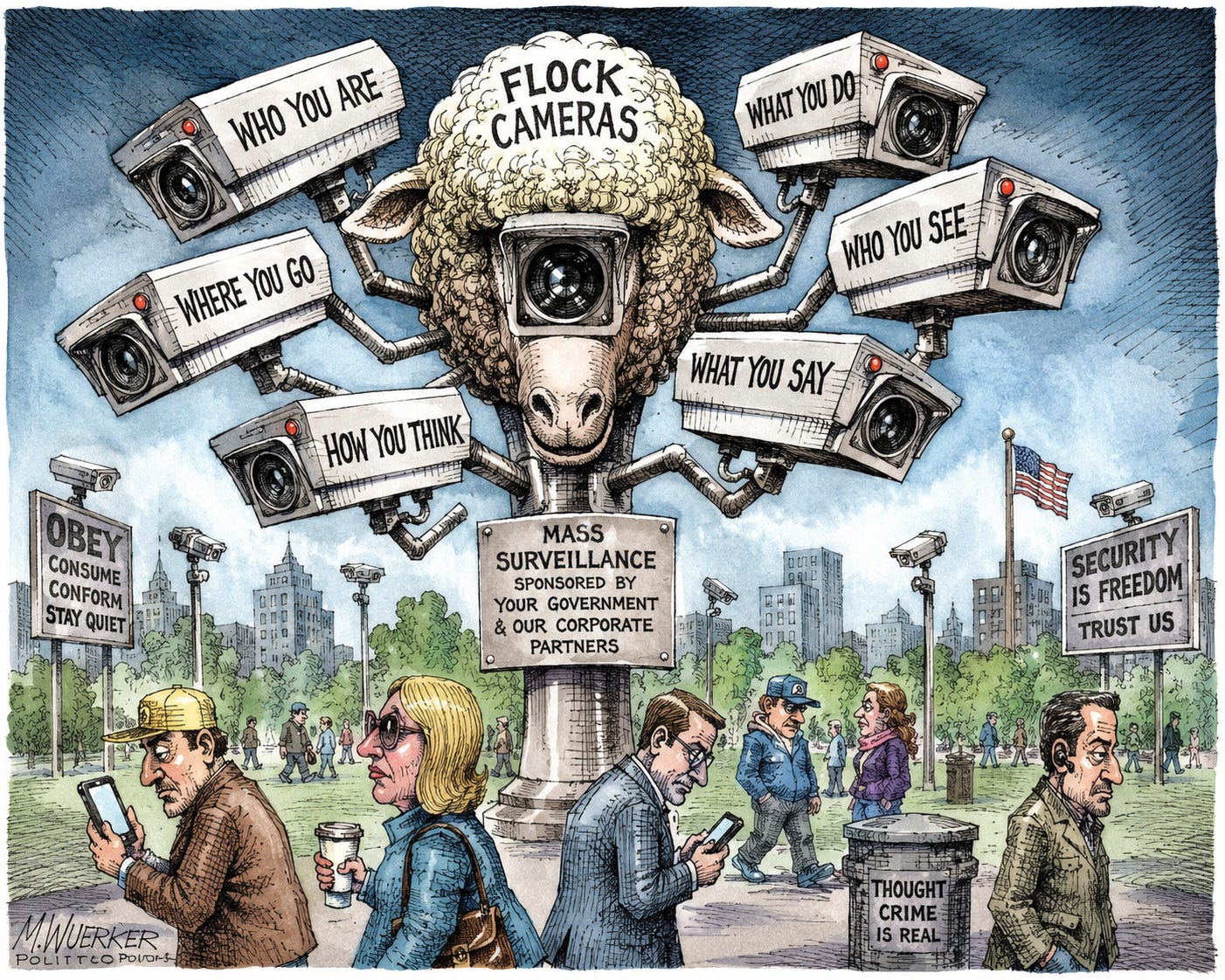
Flock Safety. Remember that name. Remember it the way you remember the names of betrayers. Thousands of their cameras—sprouting like malignant tumors on utility poles, street corners, the infrastructure of daily life—capture not merely your plate but your vehicle’s color, its distinguishing damage, the bumper stickers that announce your politics, your family, your allegiances. This data is stored for thirty days or more, accessible to any law enforcement officer with a badge and a whim, no warrant required, no judicial oversight, no accountability whatsoever. The Stasi needed human informants, paper files, shoe leather. We have gifted our would-be watchers the tools of omniscience, and we have done it willingly.
And they tell us not to worry. “Safety,” they croon, as if that word were a magic incantation sufficient to dissolve constitutional protections. “Community protection.” What manner of citizen hears this and does not feel their gorge rise? What decent person accepts the argument that the architecture of tyranny is acceptable if it catches criminals? Every gulag was built by people who believed they were protecting the community. Every surveillance state began with the promise of security.
Let me be direct about what we are discussing, because euphemism is the first collaborator of oppression. Harris County, Texas—proud possessor of more than 3,700 Flock cameras, a surveillance density that would have made the East German secret police weep with envy—recorded over five hundred murders in 2025. The cameras multiplied. The bodies multiplied. The correlation may not prove causation, but it annihilates the central lie upon which this industry rests: that ubiquitous monitoring makes us safer. It does not. It makes us watched. There is a difference, and the difference is liberty.
If you want a controlled experiment, look to the American prison. There exists no environment more comprehensively surveilled. Cameras in every corridor. Movement tracked to the minute. Privacy extinguished entirely. And yet prisons remain, by any objective measure, among the most dangerous, most violent, most anarchic places in the nation. The surveillance state cannot maintain order in environments where it faces no constitutional constraints whatsoever, yet we are expected to believe it will protect us in the open society? This is not reasoning. This is faith, and it is faith of the most dangerous kind—the worship of technology, the deification of false security.
The whistleblowers have emerged, because conscience will not be silenced forever, though God knows the machine tries. Benn Jordan, a cybersecurity researcher who investigated Flock’s systems, discovered that company employees had accessed private community center cameras more than a thousand times—including cameras monitoring daycare facilities, children’s gymnastics areas, the most vulnerable moments of family life. The justification offered? “Product demos.” No one fired. No one disciplined. The machine ground on, indifferent to the violation, contemptuous of the very concept of privacy it claims to protect.
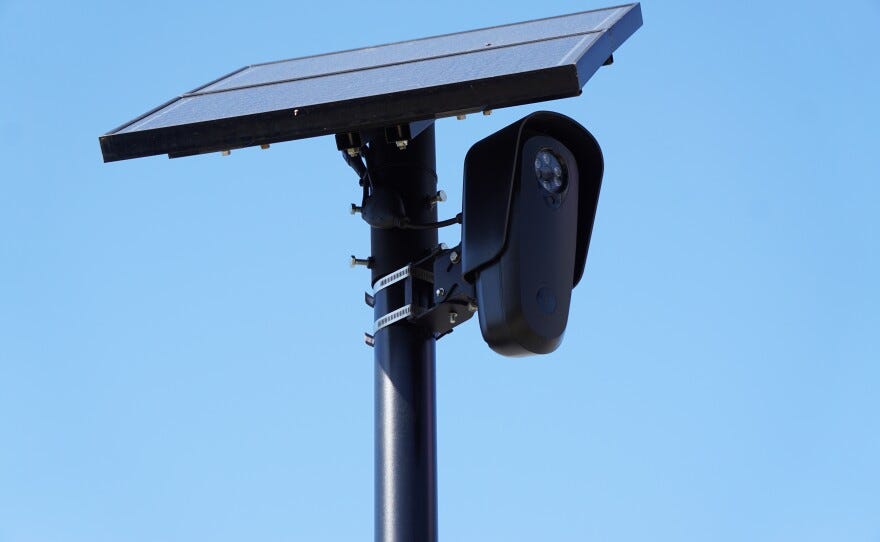
Jordan also found Flock law enforcement accounts for sale on Russian dark web forums, available to any hostile actor with cryptocurrency and malign intent, protected by security so laughable that multi-factor authentication was apparently considered too burdensome for the guardians of our safety. He reported these findings to Congress. To the Federal Trade Commission. The silence was absolute. The institutions theoretically tasked with protecting Americans from exactly this vulnerability could not rouse themselves to respond. They are either captured, incompetent, or complicit—possibly all three, and I am past caring which.
Then there is Noel Pichardo, a former police officer in Rhode Island who attended a Flock training session and emerged with his conscience intact and his career in ruins. He had been instructed in the art of warrantless tracking—how to follow any vehicle, anywhere, for any reason, without judicial oversight, without probable cause, without the constitutional protections that supposedly distinguish a free society from a police state. He refused to participate. He spoke to a reporter without departmental approval—without, in other words, permission to tell the truth.
For this act of moral independence, this refusal to collaborate, he was suspended four times. Denied seventy-two days of pay. Blocked from promotion. Barred from the sergeant’s examination. Effectively forced from the profession he had chosen to serve. The department attempted to impose a non-disclosure agreement to ensure his silence, to purchase his complicity with the promise of restored employment. When the machinery of surveillance meets the individual conscience, we now know, with perfect clarity, which prevails. The question is whether we will permit this to continue.
The founder of Flock Safety, Garrett Langley, has reportedly labeled critics “terrorists” comparable to Antifa—a characterization so simultaneously absurd and revealing that it demands examination. Here is a man whose company has erected the most comprehensive civilian tracking system in human history, who attempts partisan framing despite bipartisan opposition to his product, who cannot distinguish between legitimate democratic dissent and violent extremism. This is not a serious person. This is a person who has mistaken his commercial interests for the public good, his critics for enemies of the state, his shareholders for the citizenry. He is, in short, precisely the kind of person who should never be trusted with power over others—and precisely the kind of person to whom we have voluntarily surrendered it.
But let us step back from the particular to the general, because Flock is merely the visible tip of a deeper rot. We are witnessing the normalization of the panopticon—not as prison architecture but as civic design. Jeremy Bentham proposed his circular prison in the eighteenth century as a thought experiment in social control: the prisoner, unable to know when he was being watched, would internalize the gaze of authority and regulate his own behavior. The few would watch the many, and the many would watch themselves into submission.
What Bentham could not have anticipated was digital technology’s ability to collapse the distinction between watcher and watched, between public and private, between the citizen and the suspect. We now live in a condition of permanent potential surveillance, where the cameras may or may not be recording, where the algorithms may or may not be flagging our movements for review, where the data may or may not be retained indefinitely for future analysis by persons unknown for purposes unspecified. The uncertainty is the point. The uncertainty is the weapon.
The psychological effects are already evident, and they should alarm anyone who values the capacity for independent thought. The “chilling effect” on speech and assembly, long theorized by constitutional scholars, has become empirical reality. People self-censor. They avoid certain locations, certain associations, certain expressions of dissent. Not because they have committed crimes, but because they understand—correctly, rationally—that their movements create permanent records in databases they cannot access, controlled by entities they cannot influence, available to future regimes whose intentions they cannot predict.
This is not paranoia. This is rational adaptation to observable reality. And it represents nothing less than the transformation of the American citizen into the American subject—docile, tracked, filed, and ultimately controlled.
The expansion continues without pause, without debate, without the consent of the governed that supposedly distinguishes legitimate authority from mere domination. Flock is now developing persistent aerial drones—automated platforms that rotate to maintain continuous surveillance over designated areas. The cameras on the ground will be supplemented by eyes in the sky, invisible and unavoidable. The company claims this will enhance safety. The same claim was made about the ground cameras. The same claim was made about the NSA’s warrantless wiretapping. The same claim was made about every incremental expansion of state power over the individual in the history of organized society.
At what point do we acknowledge that the cure has become worse than the disease? When do we recognize that a life lived under comprehensive monitoring is not the life the Constitution promises, that the architecture of control, once constructed, will not be dismantled by the benevolence of those who profit from its operation?
The democratic dimensions of this crisis reveal how thoroughly our institutions have failed us. These cameras are deployed in most jurisdictions without public notification, without meaningful debate, without the consent of the governed. City councils, when confronted with Fourth Amendment concerns, retreat behind the magic incantation of “safety” as if that word alone were sufficient to dissolve constitutional constraints. The revolving door between police departments and surveillance companies creates predictable incentives for corruption—officers who oversee camera procurement find subsequent employment with the very companies whose products they championed. The public interest and private interest merge in a warm bath of mutual back-scratching while the surveillance infrastructure metastasizes.
And then there is the partisan theater that obscures the substantive issues. Langley’s attempt to frame opposition to his product as left-wing extremism would be laughable if it weren’t so strategically effective. In fact, opposition to ubiquitous surveillance has historically transcended the left-right divide. The American Civil Liberties Union and libertarian think tanks have found common cause on this issue, as have privacy advocates across the ideological spectrum. The desire to be free from warrantless monitoring is not a partisan position. It is a human position.
But the framing serves its purpose. It divides potential opposition. It allows proponents to dismiss critics as ideologues rather than principled defenders of constitutional liberty. And it distracts from the genuinely alarming reality: that a private corporation has erected, with government acquiescence if not active collaboration, a surveillance infrastructure that exceeds anything the East German secret police could have imagined.
Let me anticipate the counter-argument, because intellectual honesty demands it, even when the opposition has not earned the courtesy. The surveillance apologist will say: Criminals exist. Murders go unsolved. Children are abducted. Terrorists plot. If license plate readers can solve even one kidnapping, prevent even one bombing, isn’t the trade-off worthwhile?
This is the argument of the security state in its most seductive form, and it must be answered carefully rather than dismissed.
First, the empirical claim is false. Harris County’s 3,700 cameras have not prevented its epidemic of violence. The clearance rates for serious crimes have not dramatically improved in jurisdictions that have adopted comprehensive surveillance. The technology solves crimes after the fact, when it solves them at all; it does not prevent them. And the crimes it does solve are overwhelmingly minor—traffic violations, petty theft—while the serious offenses that justify the expense remain stubbornly resistant to technological solution.
Second, the “if it saves one life” argument is infinitely extensible and therefore meaningless. We could save lives by mandating curfews, by requiring internal passports for interstate travel, by installing cameras in every home to prevent domestic violence. We do not do these things because we recognize that security is not the only value, that liberty has worth independent of its instrumental benefits, and that a life lived under comprehensive monitoring is not the life the Constitution promises.
Third, and most importantly, the argument assumes that the surveillance infrastructure will remain in the hands of benevolent actors using it only for legitimate purposes. This assumption is not merely unwarranted; it is historically illiterate. Every tool of surveillance created for one purpose has been repurposed for others. The PATRIOT Act, sold as an emergency measure against terrorism, became routine law enforcement infrastructure. The NSA’s foreign intelligence apparatus was turned on American citizens. The question is not whether license plate readers might occasionally help solve a crime. The question is whether we are willing to pay the price—in liberty, in privacy, in the psychological conditions necessary for democratic citizenship—for marginal improvements in law enforcement efficiency. And the answer, if we are being honest, is that we have not been asked. The decision was made for us, by people who understood that public consent might be withheld if the full implications were understood.
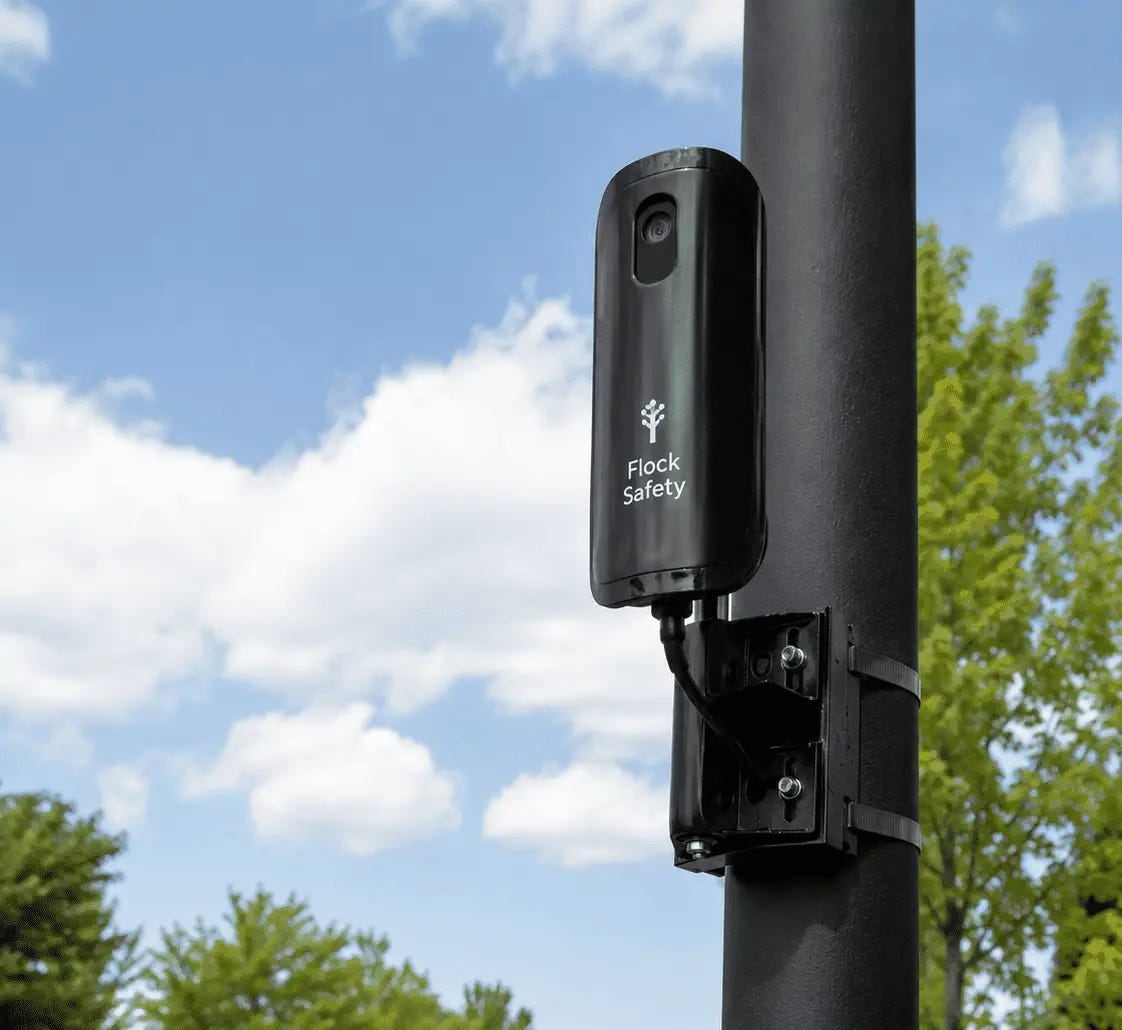
There is, however, a response emerging that should give the surveillance enthusiasts pause. In community after community, ordinary citizens—described by one observer as “sober, decent, patriotic Americans” rather than criminals or radicals—have begun taking direct action against the cameras. They are being disabled, destroyed, removed. The website Deflock.org maps camera locations, providing citizens with information that Flock’s founder has called “terrorism”—a revealing choice of words that demonstrates how thoroughly the surveillance mindset conflates transparency with threat.
This vigilantism is not, in the ideal case, how democratic change occurs. But when democratic channels are foreclosed—when city councils ignore constituents, when federal regulators ignore whistleblowers, when the courts have been slow to recognize the constitutional dimensions of automated mass surveillance—citizens are left with few alternatives. The destruction of surveillance infrastructure is the digital age’s equivalent of the Boston Tea Party: an act of property destruction undertaken in the name of liberty, against a power that has refused to hear peaceful petition.
I do not celebrate vandalism. But I understand it. And I understand that the fault lies not with those who have resorted to extra-legal means, but with those who foreclosed the legal ones. When the institutions fail, when the representatives refuse to represent, when the guardians of liberty become its grave-diggers, the people will find other means. This is not a threat. It is a prediction based on historical pattern.
Now we arrive at the constructive portion of this indictment, because contempt without construction is merely cynicism, and I have not given up. The question is: What can be done? The solutions are neither simple nor partisan. They require coalition-building across ideological lines, structural reforms that limit government and corporate power simultaneously, and a renewed commitment to constitutional principles that have fallen into dangerous disuse.
First, warrant requirements must be strengthened and enforced. The Fourth Amendment’s protection against unreasonable searches was written in an age when “search” meant physical intrusion. The Supreme Court has begun to recognize, in cases like Carpenter v. United States, that digital surveillance can constitute a search even without physical trespass. This principle must be extended to automated license plate readers, facial recognition systems, and the other tools of the surveillance state. If law enforcement wishes to track a citizen’s movements, they should be required to demonstrate probable cause to a neutral magistrate, just as they must for a wiretap or a physical search. The technology makes surveillance easier; the law must make it harder.
Second, data retention limits must be imposed. Thirty days of storage becomes permanent storage when multiplied across thousands of cameras and years of operation. Legislative limits—seven days, three days, twenty-four hours—would reduce the capacity for retroactive surveillance while preserving the technology’s legitimate uses for active investigations. The default should be deletion, not retention. The presumption should be privacy, not permanence.
Third, transparency and audit requirements must be mandatory. Citizens have a right to know where cameras are located, how often they are accessed, for what purposes, and with what results. Annual public reports should detail the number of queries, the types of crimes investigated, the clearance rates achieved, and any misuse or unauthorized access. The secrecy that currently surrounds these systems is incompatible with democratic accountability and must be shattered.
Fourth, the revolving door between government and surveillance companies must be closed. Cooling-off periods, recusal requirements, and criminal penalties for corruption would reduce the incentive for public officials to treat their positions as marketing opportunities for future employment. The public interest and private profit must be separated by more than the good intentions of those who move between them.
Fifth, private rights of action must be created. Citizens whose privacy is violated by surveillance overreach should have standing to sue for damages, without depending on government officials to enforce limits that those same officials have incentives to ignore. The courtroom has historically been where constitutional principles are given teeth; let us sharpen those teeth until they draw blood from the overreaching state.
Sixth, community control and opt-out provisions should be explored. Some jurisdictions might choose comprehensive surveillance; others might reject it. The current pattern of deployment without consent makes a mockery of local democracy. Genuine federalism would allow communities to experiment, to observe results, and to learn from one another’s experiences. The surveillance state has been imposed from above; it should be subject to approval from below.
Seventh, and most fundamentally, civic education must be renewed. The Constitution cannot protect those who do not understand its provisions or value its protections. The slow erosion of privacy has been enabled by public ignorance—of the technology’s capabilities, of the historical precedents, of the philosophical foundations of liberty itself. This is not a task for government alone; it is the responsibility of educators, journalists, parents, and citizens of conscience to ensure that the next generation understands what is being lost and what must be defended.
These measures are not utopian. They have been proposed in various forms by legislators across the political spectrum, from Rand Paul to Ron Wyden, from the libertarian right to the civil libertarian left. The coalition exists. What is lacking is the will to overcome the entrenched interests—corporate and governmental—that profit from the status quo. And that will must be generated by citizens who have finally had enough, who refuse to accept the soft cage being constructed around them, who demand that their representatives represent or be replaced.
I began with Bentham’s panopticon, and I will end with a different image: the open society, as described by Karl Popper, where institutions remain flexible, where power remains accountable, where the future remains unwritten because no one has yet succeeded in capturing the present.
The surveillance state represents the opposite vision: the closed society, where institutions serve those who control them, where power operates invisibly, where the future is determined by the data profiles of the present. This is not a future any of us chose. It is being constructed around us while we sleep, while we work, while we attend to the immediate concerns that fill our days and leave us too exhausted to notice the architecture of control rising on every street corner.
But notice we must. And resist we must. Not because we are criminals with something to hide, but because we are citizens with something to protect: the fragile, precious, improbable experiment in self-government that has been the American aspiration, however imperfectly realized, for two and a half centuries.
The cameras are watching. The only question remaining is whether we have the courage to watch back, to demand accountability, to tear down what should never have been erected, and to remind the would-be watchers that they serve at our pleasure, not the reverse.
The time for polite objection has passed. The time for submission must never arrive.
I of course am in no way endorsing any vandalism or destruction of surveillance equipment either privately or publicly owned. Especially those Flock cameras left unattended all day and night. That would be bad. Very naughty indeed. Even if it’s easy to get away with… don’t do that. Green lasers may fry their circuits but that does not mean one should obtain those relatively cheap lasers and do that. This is not an endorsement of that...
If you have nothing to hide, you have nothing to worry about. Right?
Behave. Big brother is watching.
This is Hostile Witness. Truth, with contempt of court. If you value this kind of sustained, independent analysis—if you believe that someone should be saying these things even when they are inconvenient, especially when they are inconvenient—consider becoming a subscriber. The resistance requires your support.