
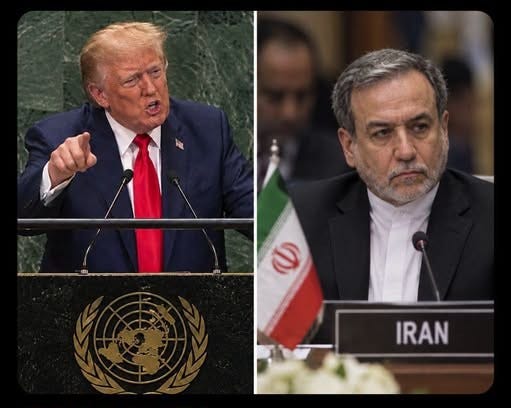
Dante put an inscription over the gate of the Inferno, and it has kept its place in the literature of despair for seven centuries: Abandon all hope, ye who enter here. I had not expected to hear it paraphrased, with no sign that the speaker knew what he was quoting, from the rostrum of the United Nations by the elected leader of the country that wrote most of the laws of war. Yet on Tuesday Donald Trump stood before the assembled nations and asked, in the rhetorical first person of a man consulting his only trusted adviser: “Do I annihilate the Islamic Republic, and do it quickly? Do I drive them into hell, with no chance of survival and no hope of future greatness for generations?”
Put like that, it is not really a question. Whenever a man asks himself aloud whether he should consign a people to damnation, the interesting part is that he thinks the matter is open.
His apologists, who by now can mount a defense in their sleep and generally do, will tell you he meant only the regime: the turbaned gerontocracy in Tehran, its hanging judges and its morality police. I would have more sympathy for this reading if I had spent less of my life despising that regime myself. But look at the sentence again. For generations. A regime has no generations. Clerics do not bequeath the velayat-e faqih to their grandchildren the way a family leaves the silver. Generations belong to peoples, to the children of Shiraz and Tabriz not yet born, and those are the people whose future he offered to cancel. This is the sort of carelessness that tells you a man’s convictions better than his care ever could.
Nor was it a slip. In April, with an ultimatum running out, he announced that “a whole civilization will die tonight, never to be brought back again,” and added, like a weatherman apologizing for the forecast, “I don’t want that to happen, but it probably will.” He promised that every bridge and every power plant in Iran would be left “burning, exploding,” and he mused about the desalination plants, which in that parched country turn seawater into water that children can drink. There is a pattern, and it has an inventory: the bridges, the electricity, the water, the civilization, and now its descendants. At some point the “he meant the regime” defense has to explain why every target on the list turns out to be something civilians need in order to breathe.
As for the timing, five days before this oration a UN fact-finding mission reported grounds to believe that the United States had committed war crimes in this same war. Among the cases was the destruction of a primary school in Minab, where about 120 children were killed on the first day by American Tomahawks aimed with stale coordinates, after warnings that the data was out of date went unheeded. The mission noted the murals on the walls and the playground in the yard. The President’s contribution to that week’s reflection was to tell the General Assembly that the International Criminal Court is “full of evil people.” Irony, as Tom Lehrer said when Kissinger won the Nobel Peace Prize, has been rendered obsolete.
The rest of the speech gave the atrocity its cushioning, and I suspect that cushioning is the whole purpose of the clowning. He informed the world that “the use of the word artificial makes intelligence fake.” By that logic plastic surgery slanders the polymer and artificial sweetener defames the sugar beet. One could observe, gently, that he has spent a decade demonstrating the reverse proposition: that intelligence can be entirely natural and still counterfeit. He took credit for ending eight wars while presiding over a ninth. The delegates, who have learned to treat these performances as bad weather, sat through it. A threat that would have ended a presidency in 1962 now arrives sandwiched between a lexical complaint and a grievance about the escalator, and it scrolls past in the feed somewhere between a recipe and a cat.
Then came the clause that gives the game away: “I believe we’ll make a deal, right after the election.” The midterms, he meant. So the choice between negotiation and the annihilation of a nation is apparently to be scheduled around the electoral calendar of one American party. Clausewitz called war the continuation of politics by other means. It took this President to show that the politics in question could be a congressional campaign.
I hold no brief for the Islamic Republic. It is a theocratic racket, a nest of hangmen that met its own citizens’ protests over the past year with bullets, blackouts and disappearances, all of which the same UN mission documented in detail. That is exactly why this bluster is so contemptible. Every tyranny’s founding lie is that the nation and the regime are one body, so that to strike at one is to strike at both. The mullahs have spent forty-seven years trying to teach their subjects that lesson. In a single sentence, from the most powerful rostrum on earth, the President of the United States taught it for them, gratis. The Great Satan used to be a figure of clerical propaganda. He now appears to be volunteering for the part.
There is a remedy, and it is older than any of us. The Constitution gives the war power to Congress, which this summer passed a resolution telling the President to withdraw and then watched him treat it as a greeting card. Congress could stop legislating by sentiment and start legislating by appropriation, cutting off the money for any war it has not authorized. That is a principle that constitutional conservatives and anti-war progressives both claim, and neither has yet found the nerve to enforce it.
Until then we are left with a man who stood at the world’s parliament and weighed aloud whether to open the gates of hell to a people, and who seemed faintly pleased to find the key in his pocket. Dante reserved the lowest circle for traitors, frozen in ice. He never met a demagogue who proposed to bring the fire to other people and then check the polls before striking the match. Posterity will have to find him a circle of his own.