
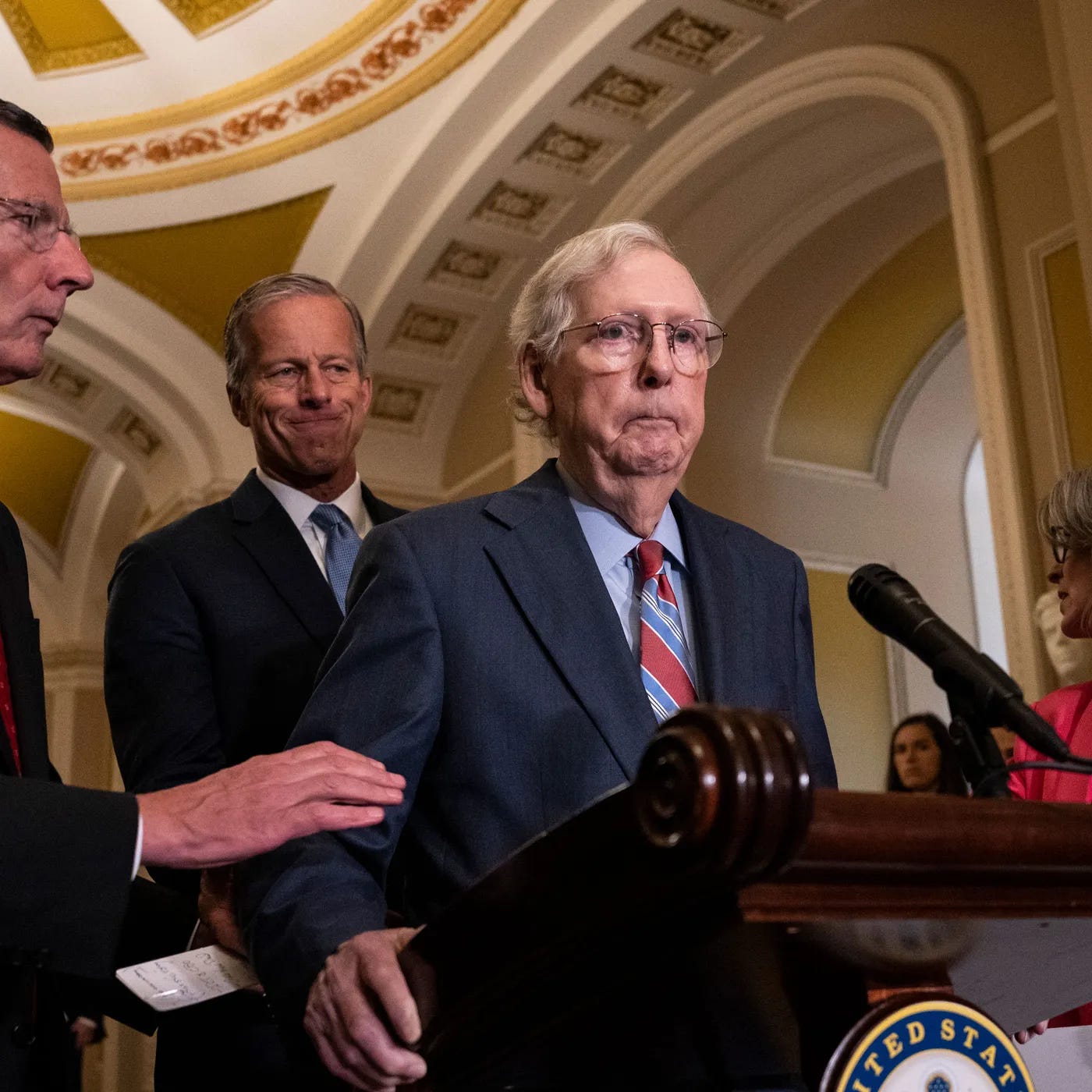
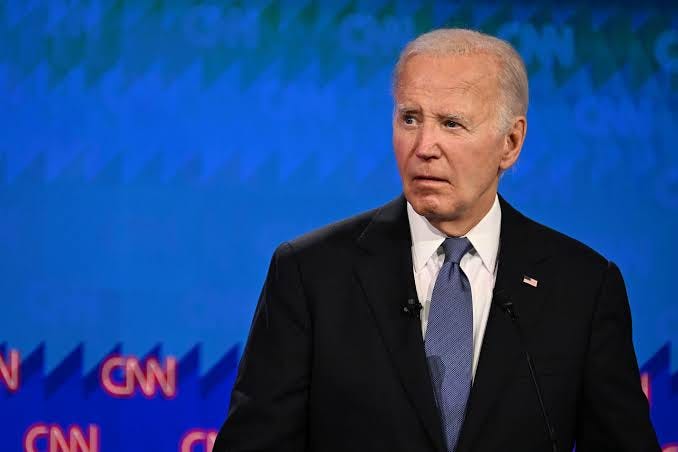
One watches with a sort of sick fascination as the American political class performs its increasingly unconvincing pantomime of competence. There was Senator McConnell, frozen at the podium like a malfunctioning animatronic, his colleagues rushing to prop him up as if this were merely a momentary technical difficulty rather than a terrifying glimpse into the void. There is President Biden, stringing together non-sequiturs with the confidence of a man who has forgotten what he was saying three sentences ago. There was the late Senator Feinstein, reportedly so cognitively impaired that her staff had to guide her through votes, effectively transforming the people’s representative into a marionette operated by unelected aides.
These are not partisan observations; they are empirical ones. They are the visible manifestations of a system that has become, to borrow a phrase from Orwell, a sort of gerontocratic absurdity. We have constructed a political apparatus that requires the cognitive acuity of a chess grandmaster but provides no mechanism for verifying that those who wield its power possess even the basic faculties of a competent adult.
The United States Constitution, in its finite wisdom, establishes minimum ages for federal office; 25 for the House, 30 for the Senate, 35 for the Presidency - as if the framers somehow imagined that maturity was a one-way ratchet, that having achieved the requisite years, one could never regress. The 25th Amendment provides a mechanism for addressing presidential disability, but it requires either voluntary declaration of incapacity (a rarity among the narcissistic personality types drawn to power) or action by the vice president and Cabinet (a politically fraught maneuver that would require more courage than typically exists in Washington).
And for Congress? Nothing. The Constitution grants each house the power to judge the qualifications of its members, but this has been interpreted so narrowly as to exclude the one qualification that might actually matter: the ability to think clearly.
What we have created is a system of government without a safety net, a constitutional framework that assumes the best of human nature while providing no remedy for its inevitable decline. It is rather like designing an aircraft without any instruments to indicate whether the pilot has fallen asleep at the controls.
The problem transcends age, though age is certainly a significant factor. While cognitive decline is more common in older individuals - approximately one in nine people aged 65 and older has Alzheimer’s disease, according to the Alzheimer’s Association - early-onset dementia, stroke, medication side effects, and other health conditions can affect cognitive function at any age. What we need is not age discrimination but cognitive verification.
I propose what should be an uncontroversial solution: a standardized cognitive fitness assessment for all federal elected officials. This is not a radical idea; it is merely the application of common sense to a problem that common sense created. We require commercial airline pilots to undergo regular medical examinations because we recognize that the lives of hundreds depend on their cognitive fitness. We subject military officers to regular assessments because we understand that national security requires mentally competent leadership. Yet we allow those who control our nuclear arsenal to serve without any verification of their cognitive fitness whatsoever.
The proposal is simple enough:
Annual cognitive assessments conducted by independent medical professionals, testing executive function, information processing speed, working memory, cognitive flexibility, and decision-making under pressure. The results would be classified simply as “Fully Fit for Duty,” “Fit with Accommodations,” “Further Evaluation Required,” or “Not Fit for Duty.” Detailed medical information would remain confidential, with only fitness classifications disclosed to appropriate authorities. Those unable to serve would receive full retirement benefits and a dignified transition period.
This is not a punitive measure; it is a protective one. It protects the public from impaired leadership while preserving the dignity of those who have dedicated their lives to public service. It transforms what is now a source of political speculation and media sensationalism into a matter of medical science and constitutional governance.
The objections will be predictable. Some will cry age discrimination, though the proposal applies to all officials regardless of age. Others will invoke medical privacy, though only fitness classifications would be disclosed, not detailed medical information. Still others will recognize it as a threat to their continued tenure in office, which is precisely the point.
The historical precedents are clear. After the assassination attempt on Ronald Reagan - whose cognitive decline during his presidency is well-documented, with CBS News reporter Lesley Stahl recalling him “seemingly glazing over and not remembering her during a meeting in 1986, more than two years before he left office” - procedures were established for transferring power during medical procedures. What I’m proposing is simply extending this recognition of fitness requirements to the cognitive domain.
As Harvard bioethics professor Francis Shen told Bloomberg Law regarding judges with dementia, “It’s really problematic to have a combination of life tenure with no - and I mean zero - check-ins for cognitive ability.” The same could be said for our highest elected offices, where the stakes are infinitely higher.
This isn’t about removing older leaders from office; it’s about ensuring that all leaders, regardless of age, possess the cognitive capacity to fulfill their constitutional responsibilities. It’s about protecting our republic from the dangers of impaired leadership while preserving the dignity of those who have dedicated their lives to public service.
The health of our democracy depends on the fitness of those who lead it. It’s time we established clear standards for cognitive fitness in public service - not as a weapon against aging leaders, but as a safeguard for our constitutional system and the American people.
To do otherwise is to abandon reason itself, to pretend that the inevitable biological realities of human aging somehow stop at the doors of power. It is to maintain a fiction that serves no one except those too impaired to recognize their own decline.
References:
Klippenstein, K. (2023). “The Risks of Dementia in the House, the Senate—and the White House.” The Nation.5
“Should Aging U.S. Politicians Have to Pass Cognitive Tests?” (2023). TIME.6
Klippenstein, K. (2023). “Pentagon-Funded Study Warns Dementia Among U.S. Officials Poses National Security Threat.” The Intercept.1
“Concern about the age of many US party leaders has spread beyond the presidency.” (2023). The Guardian.2
“News Analysis: It’s not just Feinstein. McConnell episode highlights age, vulnerability of U.S. leaders.” (2023). Los Angeles Times.4
Budson, A. (2024). “Are Verbal Flubs by Trump or Biden Signs of Cognitive Decline or Innocent Mistakes?” BU Today.7
Vossel, K. (2023). “What we can learn in the ‘era of cognitive challenges.’” Los Angeles Times.8
“New book on Biden by Jake Tapper and Alex Thompson reports a ‘cover-up’ about his decline.” (2024). Reddit.9
“A Modern Day Sparta: The American Gerontocracy and the National Security Implications of Elderly Rule.” (2023). Georgetown Security Studies Review.3
“Conspiracy Theories Around Lawmakers’ Health Are Going to Keep Spiraling.” (2024). Talking Points Memo.10