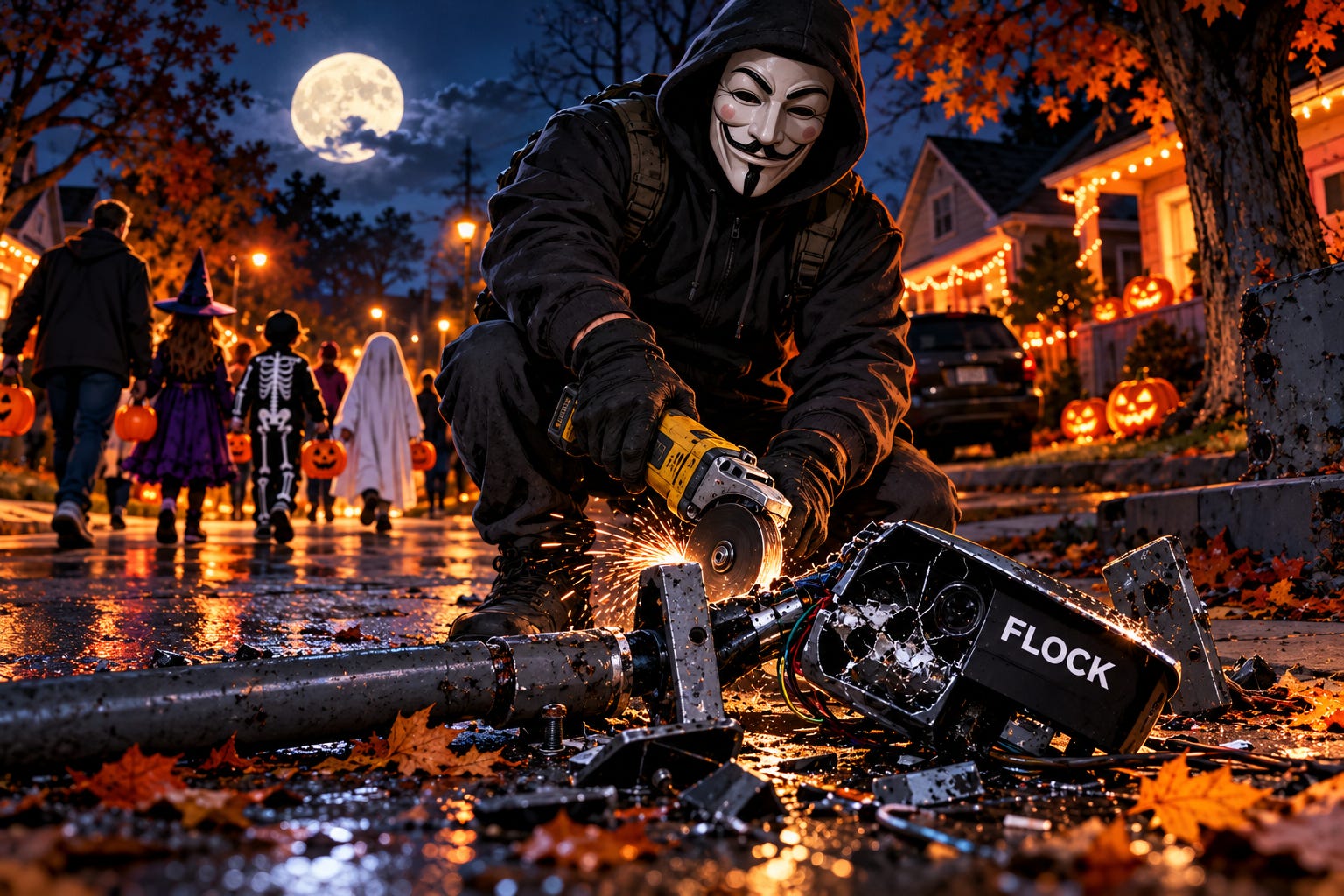

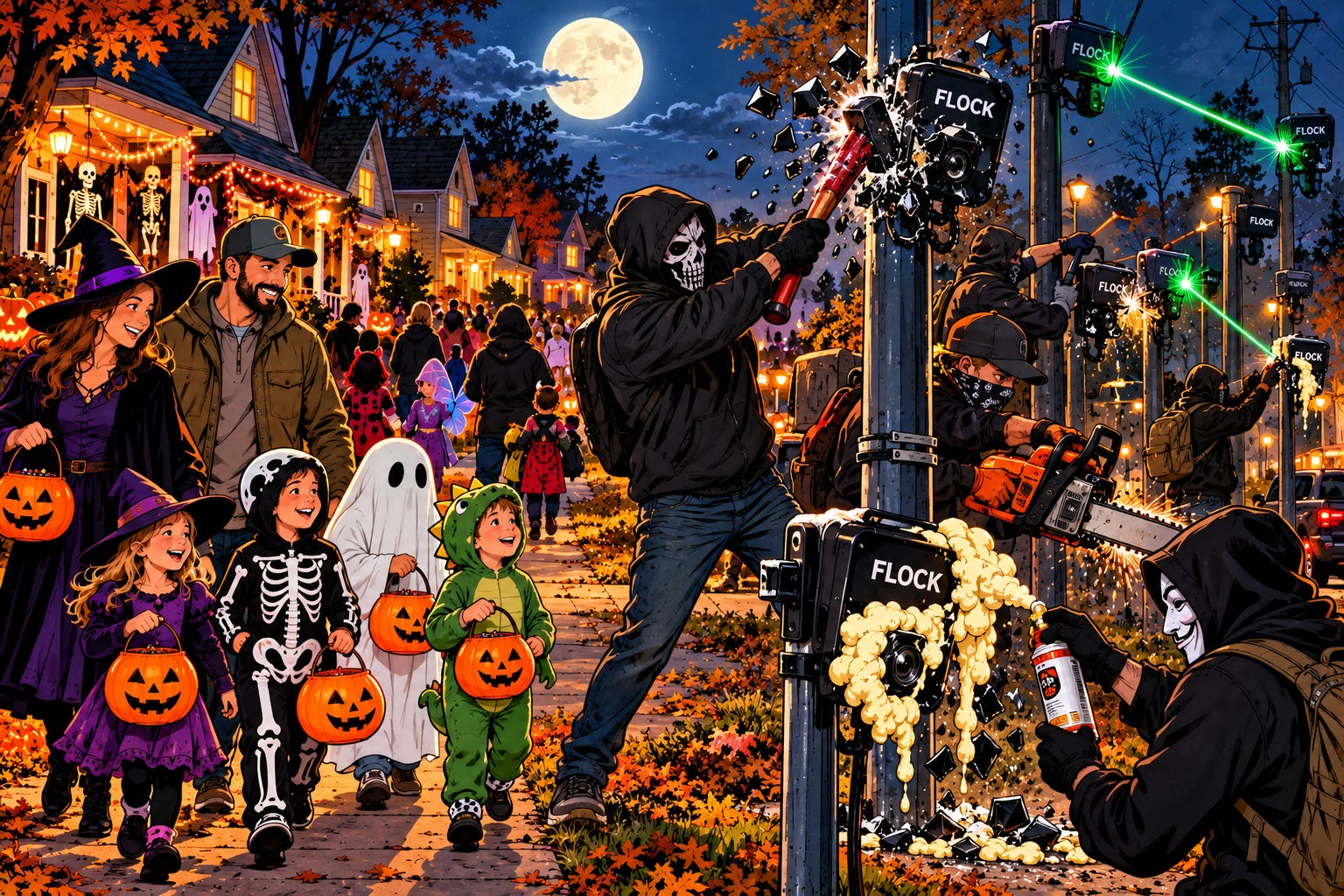
Ah, the delicious irony of it all! The very night when society encourages its citizens to don masks and adopt false identities might just become the moment when authentic rebellion against the surveillance state finally finds its footing. How perfectly fitting that Halloween—the celebration of the uncanny and the subversive—should be chosen as the appropriate time to strike back against these metallic sentinels of our modern panopticon.
Let us be perfectly clear about what these Flock cameras represent: they are not mere crime-fighting tools, as their corporate apologists and law enforcement sycophants would have you believe. No, they are the physical manifestations of a creeping authoritarianism that would have made Orwell himself blush. These automated license plate readers, numbering in the hundreds of thousands across nearly every state, constitute nothing less than a warrantless dragnet surveillance apparatus that records the movements of every vehicle that passes by—not just those suspected of crimes, but yours and mine and everyone’s. They are the electronic eyes of a state that has abandoned the Fourth Amendment’s protection against unreasonable searches in favor of a perpetual digital stakeout of its citizenry.
The company’s recent concessions—reducing data retention periods from thirty days to seven, announcing “mandatory misuse detection”—are nothing but pathetic attempts to placate growing public outrage. They are the equivalent of a burglar politely wiping his feet before ransacking your home. Meanwhile, reports emerge of ICE agents accessing local police systems without proper authorization, and police officers using this technology to stalk former partners. These are not isolated incidents; they are the inevitable consequences of a surveillance infrastructure that operates with minimal oversight and maximum intrusion.
The “De-Flock America” movement, as it has been dubbed, represents not mere vandalism but a form of digital self-defense. When the law fails to protect citizens from unwarranted surveillance, when the courts refuse to recognize that constant tracking constitutes an unreasonable search, when corporations and governments conspire to monitor our every move, what recourse remains but direct action? The suggestion that Halloween costumes and masks might provide cover for such action is not cowardice but pragmatism—a recognition that in a society where dissent is increasingly criminalized, anonymity becomes a revolutionary act.
Of course, the naysayers will emerge from their comfortable corners to tut-tut about property rights and the rule of law. They will tell us that damaging these cameras constitutes criminal behavior, that there are “proper channels” for addressing grievances. But what proper channels exist when the very institutions meant to protect our rights have become complicit in their erosion? What recourse remains when petitions are ignored, when public comment periods are mere formalities, when elected officials answer more to corporate lobbyists than to their constituents? The suggestion that local advocacy has succeeded in some communities—like El Cerrito, California, where the city voted against renewing its Flock contract—merely proves the exception that highlights the rule: most communities lack either the awareness or the organization to mount such resistance.
The comparison to “The Purge” is particularly apt, though not in the way most commentators mean it. The real purge is not the hypothetical destruction of surveillance cameras one night a year; it is the ongoing purging of our privacy rights, our constitutional protections, our very ability to exist without being monitored, catalogued, and filed away in some government database. The proposed Halloween action is not a purge but a cleansing—an attempt to wash away the stain of constant surveillance that has spread across our communities like oil on water.
Some will argue that these cameras help recover stolen vehicles and find missing persons. But at what cost? Are we willing to trade our fundamental right to travel without being tracked for the marginal increase in law enforcement efficiency? Are we so desperate for security that we will willingly build our own cages? The answer, for a free people, must be no.
The beauty of the Halloween proposal lies in its recognition that power responds not to petitions but to consequences. When a company can deploy hundreds of thousands of cameras across the nation with minimal resistance, it learns that the public will tolerate any intrusion. When those cameras begin to disappear, to be disabled, to be rendered useless, the company and its government partners learn a different lesson: that there are limits to what a free people will endure.
Let us be clear: this is not about mindless destruction. It is about targeted resistance against the infrastructure of surveillance. It is about reclaiming, even for one night, the right to exist without being watched. It is about demonstrating that the consent of the governed can be withdrawn, even if only through the symbolic act of disabling the cameras that represent that withdrawal.
The critics will call this criminal behavior. They are wrong. What is criminal is the systematic violation of our constitutional rights under the guise of public safety. What is criminal is the creation of a surveillance state that would have terrified the very founders who crafted the Fourth Amendment. What is criminal is the transformation of our public spaces into zones of perpetual monitoring where every movement is recorded, every action logged, every person treated as a potential suspect.
So on October 31st, as children go door-to-door in costumes that hide their identities, perhaps some of their elders will engage in a different kind of masquerade—one that hides their identities while revealing their commitment to freedom. Perhaps the streets will be filled not only with ghosts and goblins but with the sounds of surveillance cameras being disabled, covered, or removed. Perhaps Halloween will come to mean something more than candy and costumes—it might come to mean the night when Americans began to take back their privacy, one camera at a time.
So let the masks go on, let the cameras come down, and let freedom ring through the streets on Halloween night. They say bad times create strong men. This is your calling. It’s time to fight back. Make it count!