
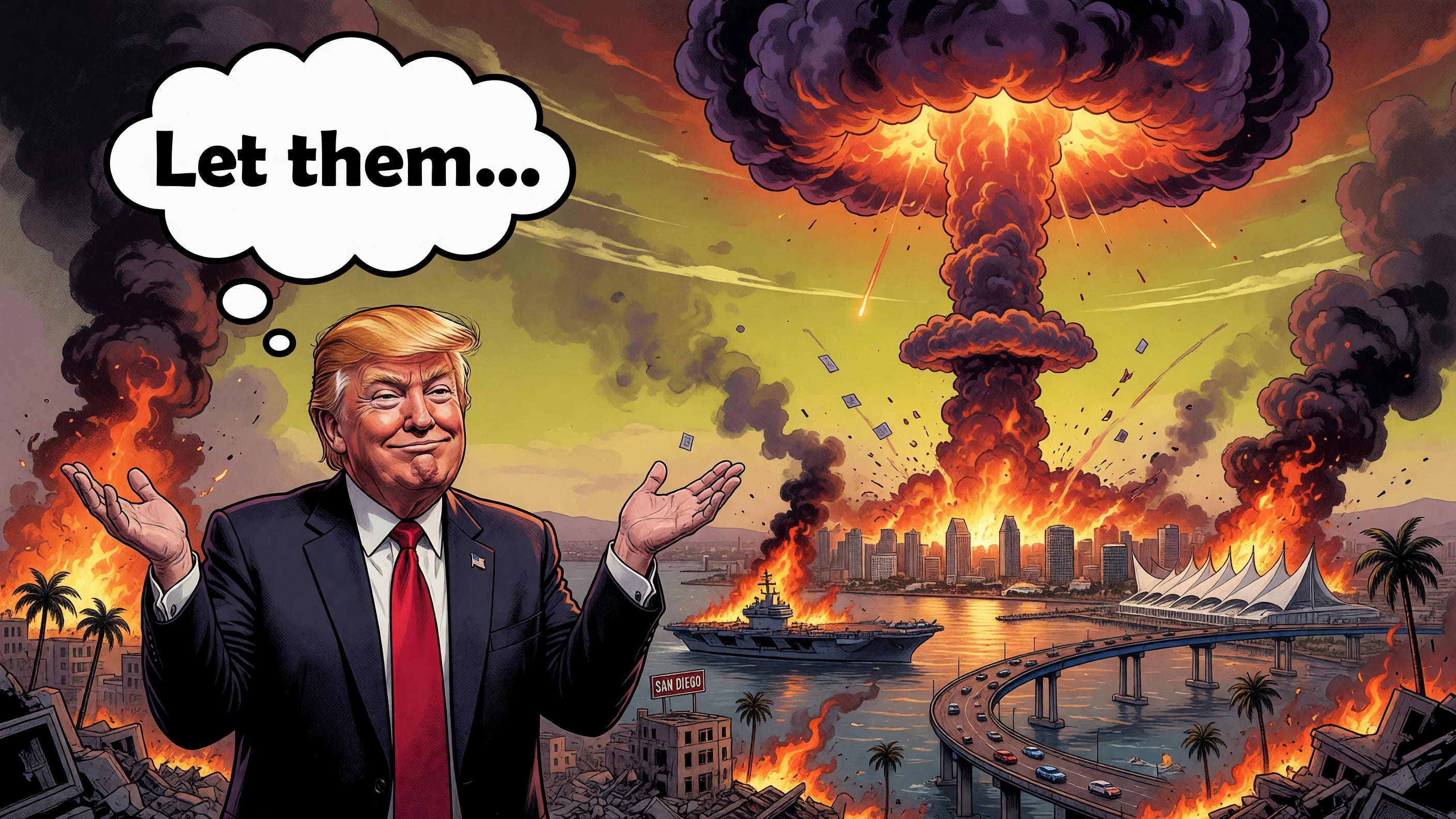
One must pause, if only for a moment, to appreciate the sheer, unvarnished obscenity of the thing. Here stands a man—if one may dignify this bloated, bronzed mediocrity with the term—who has sworn an oath to protect the Constitution, casually offering up ten million of his own countrymen as a “small price to pay” for his own geopolitical vanity. Not content with the habitual degradation of the office he occupies, he must now audition for the role of Nero, fiddling not while Rome burns, but while he proposes the arson himself.
Let us be precise about what occurred in that Nebraska tent of the damned. The President of the United States. This purported Commander-in-Chief who once hid in a catering container rather than face the consequences of his own warmongering, stood before a mob of the credulous and suggested that the obliteration of Los Angeles and San Diego would constitute acceptable collateral damage. “Let them take out a city,” he drawled, with the smug indifference of a man who has never faced consequences for anything in his eighty years of cosmic impunity. The applause that followed was the sound of civic responsibility being strangled in its crib.
The “small price,” you see, is other people’s lives. Not his. Never his. The golden towers of Manhattan, where he made his name defrauding contractors and bankrupting casinos, are safe. Mar-a-Lago, that gilded mausoleum of the American id, is safe. But Los Angeles? San Diego? These are cities that voted against him. These are populations that have the temerity to contain brown people, liberals, environmentalists; enemies in the ongoing war against reality that consumes what remains of his syphilitic attention span. So let them burn. Let them be turned to glass. It’s a “small price” for the great man to pay with other people’s blood.
This is not mere recklessness. Recklessness implies a lack of foresight, an accidental veering into danger. This is something far more sinister: the deliberate, gleeful normalization of civic murder. It is the rhetoric of the bunker, the language of a man who views his own citizenry not as constituents to be protected but as bargaining chips to be wagered in the casino of his ego.
What’s happening here is one of two possibilities—or, this being Trump, both simultaneously operating in the diseased ecosystem of his consciousness:
First, the conflation of economic pain with literal annihilation. The “small price to pay” was intended, one suspects, to refer to inflation and gas prices—the banal hardships of his trade war. But in the labyrinth of that unwell mind, the concept of “price” became literal. His brain, always seeking the most sensational route to the dopamine hit, skipped tracks from higher prices at the pump to the vaporization of ten million souls, treating both as equally acceptable entries in the ledger of his vanity.
Second—and here we descend from incompetence to malice—the “joke.” Los Angeles and San Diego are not merely cities; they are symbols of the California he despises, deep blue strongholds in a state that has consistently rejected his advances. The timing is exquisite: weeks before midterms, with no electoral stake in their survival, he treats millions of American lives as a punchline designed to own the libs. The cruelty is the point. The suggestion that these particular populations are expendable is red meat for the base, a signal that he alone is willing to transgress the ultimate taboo in service of partisan vengeance.
When Nero fiddled while Rome burned, we marked the apotheosis of imperial indifference. Trump has dispensed with the music entirely—he simply names the cities, shrugs his shoulders, and calls the ashes a bargain.
And what of the “artificial” war he mentions? The conflict he reignited after tearing up the Iran deal, against the advice of anyone with a functioning medulla oblongata, now becomes “artificial” when the bill comes due. How convenient. How utterly, predictably Trumpian. The man who has never paid a debt in his life now proposes to discharge this one with the lives of Californians. The bankruptcy laws of the soul do not apply to him; he simply declares moral insolvency and moves on to the next grift.
Consider the cowardice wrapped inside the bravado. This is a man who faked bone spurs to avoid Vietnam, who trembled at the thought of Iranian retaliation, who speaks of military valor only from the safety of a teleprompter, and yet he proposes to sacrifice millions with the casual air of a man ordering steak well-done with ketchup. The contrast would be comic if it weren’t so catastrophically dangerous. He is simultaneously the most terrified and the most reckless man in American public life; a trembling hand on a nuclear trigger, daring the world to call his bluff while praying someone takes the gun away.
But we must not let the absurdity distract from the horror. This is how republics die—not with a bang, not even with a whimper, but with a reality television host suggesting that the opposition’s cities are expendable, and the crowd roaring its approval. This is the logic of the purge, the rhetoric of the civil war. When a leader begins to speak of his own population as acceptable losses, he has crossed the Rubicon into a territory where no election, no Constitution, no norm can constrain him. He has announced, in effect, that the social contract is null and void. That he is not the president of all Americans, but merely the vengeance angel of his base, willing to see the rest reduced to radioactive ash if it serves his narrative.
So, Los Angeles and San Diego—those teeming, polyglot, creative cities that represent everything this cretinous nationalist despises—are offered up as propitiatory sacrifices to the god of his poll numbers. Let them be taken out. Let them burn. It’s a small price to pay for the continued adulation of the mob, for the dopamine hit of the news cycle, for the fleeting sensation that he is, in fact, a big man rather than the hollow, haunted husk of a failed internet meat salesman.
History will not be kind to this moment. Future generations—if we are fortunate enough to have them—will look back with incredulity that such words were spoken by an American president, and that they were met not with immediate removal from office but with partisan parsing, with “context” and “interpretation,” with the usual mealy-mouthed equivocations of a political class that has lost the courage to call wickedness by its name.
He is not just reckless. He is not just dangerous. He is contemptible—a word I use with precision. Contemptible in his cowardice, contemptible in his cruelty, contemptible in his complete and utter unworthiness of the office he defiles with every exhalation. That he should offer up American cities as a “small price” while he himself would not pay a large price to save them. That he should speak of sacrifice while his entire life has been a monument to selfishness. This is the final, vulgar insult to the intelligence and the conscience of a nation that deserves so much better than to be led by this tinpot Nero with a spray tan and a grievance.
The small price, Mr. President, is your resignation. The large price is our continued tolerance of your presence in the house that Lincoln built. Pay one or face the other. The clock is ticking, and the cities you named still stand—despite your best efforts to place them in the crosshairs.