
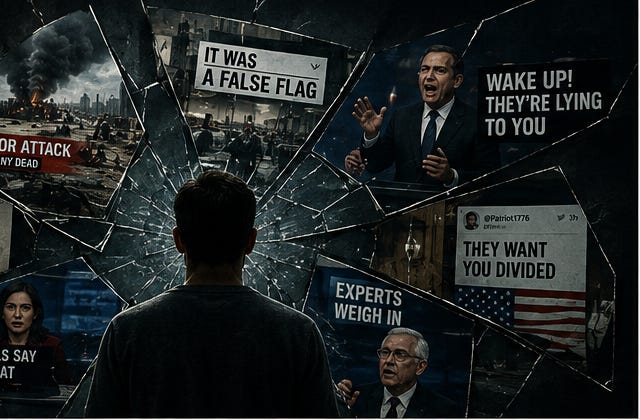
There is a sickness in the modern mind, a profound and dangerous rejection of reality that has become the defining characteristic of our age. We are living through what can only be described as the Age of Unreason, a collective decision to sever our connection from the anchor of objective truth and set sail into the boundless, treacherous ocean of subjective narrative. This is not a new phenomenon, for the human appetite for comforting falsehoods is as old as language itself, but never has it been so democratized, so monetized, and so utterly pervasive as it is today. The modern influencer, the podcaster, the professional provocateur—these are merely the latest, most efficient vectors for a disease that has been incubating for decades, a plague of unreason that threatens the very foundations of our civilization.
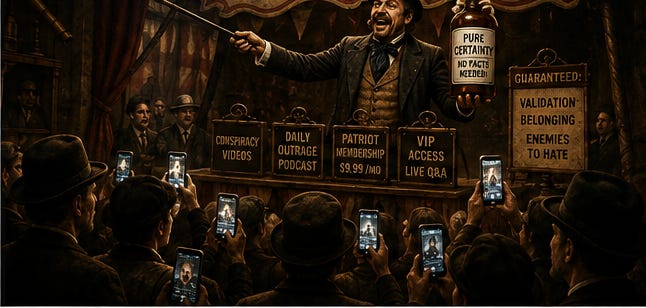
Let us be clear about what this is. It is not merely the spread of misinformation, a term too clinical and too forgiving for what we are witnessing. This is the deliberate, often gleeful, construction of alternate realities, each one a self-contained ecosystem of grievance, paranoia, and validation. The grifters who peddle these realities are the modern equivalent of the medieval pardoners, selling indulgences not for sins of the flesh but for sins of thought, absolving their followers of the burden of critical thinking. And like those pardoners, they have grown fabulously wealthy from the trade.
On the right, this pathology has reached its most florid and destructive form. Consider the grotesque carnival of Alex Jones, a man so devoid of basic human decency that he built an empire on the corpses of children. His claim that the Sandy Hook shooting was a “giant hoax” perpetrated by “crisis actors” was not a mere mistake or a misguided opinion; it was an act of moral depravity, a deliberate infliction of trauma upon parents who had already endured the unimaginable. For this, he was rewarded with millions of followers and a fortune in revenue, his lies becoming the foundational texts of a movement that would eventually seize the highest office in the land. Jones represents the terminal stage of this affliction: the complete and total rejection of observable reality in favor of a narrative so all-encompassing that it can explain away any inconvenient fact, including the murder of first-graders.
Then there is the more respectable face of this madness, the smirking, faux-intellectualism of Ben Shapiro, a man who has made a career out of high-speed gish gallops, delivering a torrent of half-truths, strawman arguments, and outright falsehoods with the confidence of a man who has never once in his life questioned his own righteousness. His entire shtick is a performance of intellectual rigor, a rapid-fire delivery designed to overwhelm rather than enlighten, to create the impression of a mind so sharp and so well-stocked with facts that it cannot be challenged. But scratch the surface, and you find not a scholar but a sophist, a debater who prizes winning over truth, who has built a brand on telling his audience exactly what they want to hear: that they are the rational ones, that their opponents are not merely wrong but evil, that the world is a simple binary struggle between the righteous and the wicked.
But let no one be so foolish as to believe this is a sickness confined to the right. The left, in its own way, has become an equally fertile breeding ground for unreason, trading the conspiracies of the deep state for the dogmas of social justice, where reality is subordinate to ideology. Here, we find the likes of Shaun King, a man who has built a career on the performance of wokeness, who has raised millions of dollars on the promise of fighting racial injustice, only to see those funds disappear into a vortex of questionable accounting and personal enrichment. Here, we find the academic-turned-activist who tells us that mathematics is racist, that grammar is a tool of oppression, that objective truth itself is a construct of white supremacy. This is the left’s version of QAnon: a conspiracy theory so vast and so all-encompassing that it can explain away any failure, any contradiction, any inconvenient fact. The world is not complex; it is simply a matrix of power and oppression, and those who cannot see it are not merely mistaken but complicit.
We must go back in time to see the roots of this infection. We can trace its lineage to the 1960s and 70s, to the moment when the counter-culture’s healthy skepticism of authority curdled into a toxic rejection of all expertise. The anti-war movement, which began as a principled stand against a disastrous conflict in Vietnam, soon spawned a thousand conspiracy theories about the CIA, the military-industrial complex, and the “hidden hands” that controlled the world. The environmental movement, born of a genuine concern for the planet, soon gave rise to a New Age spirituality that rejected science in favor of “alternative” medicine, crystal healing, and channeling. The left’s embrace of postmodernism in the 1980s and 90s, with its insistence that all knowledge is socially constructed and that there is no such thing as objective truth, was the intellectual equivalent of leaving the front door of civilization unlocked and putting out a welcome mat for every charlatan and grifter who happened by.
The right, for its part, has its own historical lineage. We can trace it back to the McCarthy era, to the paranoid style of American politics that Richard Hofstadter so brilliantly identified, the belief that the world is controlled by a vast, shadowy conspiracy of subversives seeking to destroy the American way of life. We can see it in the John Birch Society, in the militia movements of the 1990s, in the endless supply of right-wing newsletters that warned of the coming one-world government and the imminent imposition of martial law. The right’s embrace of fundamentalist Christianity, with its literal interpretation of scripture and its rejection of scientific evidence, created a constituency that was already primed to believe in invisible forces and hidden truths, a constituency that would prove to be fertile ground for the conspiracy theories of the 21st century.
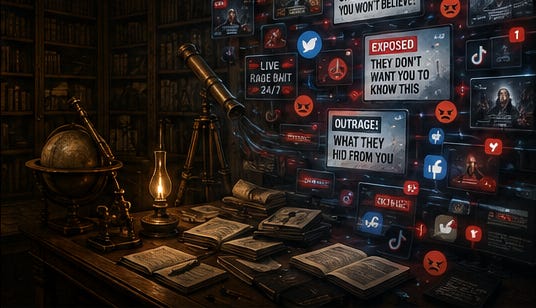
The internet, of course, was the accelerant that turned this slow-burning fire into a raging inferno. It created a media ecosystem in which the traditional gatekeepers of truth—journalists, editors, publishers, academics—were rendered obsolete, replaced by algorithms that rewarded not accuracy but engagement, not wisdom but virality. The internet did not create the grifters and charlatans, but it gave them a global platform, a direct line to millions of eager believers, and a business model that monetizes their every utterance. It created a world in which a former game show host with a Twitter account could become the most powerful man on earth, and a man with a webcam and a head full of nonsense could reach more people than the most respected newspaper in the country, and admittedly, where a home remodeler can spit his polemic like a cobra spitting venom at an annoying pungi player.
The consequences of this Age of Unreason are not abstract or theoretical; they are immediate and devastating. We are living in a country where foundational, shared understandings of reality are dissolving before our eyes. Where basic scientific and historical consensus is treated as just another opinion, where the very mechanisms of a functioning society are corroded by mistrust and paranoia. We are living in a country where the pursuit of knowledge is often seen as an act of betrayal, and where the very idea of a shared reality is collapsing, where we can no longer even agree on the basic facts of our existence.
This is the great and terrible danger of this parasitic trend: it erodes the very foundation of civilized discourse, which is the shared acceptance of a common reality. We cannot have a debate about policy if we cannot first agree on the basic facts of the world. We cannot address a crisis if a significant portion of the population believes the crisis is a hoax. We cannot maintain a functioning democracy if a large and growing segment of the electorate is living in an alternate reality, fed to them by grifters and charlatans who profit from their confusion and their anger.
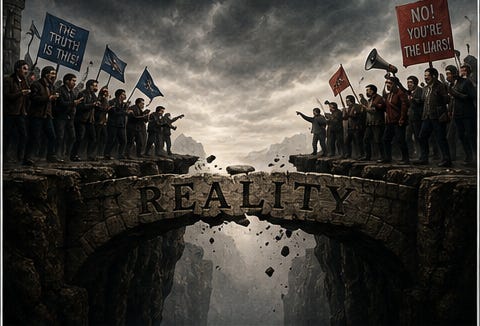
The result is a society that is increasingly incapable of collective action, a nation that cannot agree on what is real, what is true, what is important. This is not a harmless eccentricity; it is a form of societal suicide. It is the abandonment of the Enlightenment itself—the belief that through reason, evidence, and critical inquiry, we can understand the world and improve our condition within it. In its place, we have the cult of personality, the tyranny of opinion, the relentless march of the grifters.
What is to be done about this? The answer, I fear, is not comforting. There is no simple solution, no legislative fix that can repair the damage that has been done. The problem is not merely one of regulation or censorship; it is a cultural and spiritual crisis, a loss of faith in the very idea of truth itself. We have created a media ecosystem that rewards not accuracy but engagement, not wisdom but virality, not nuance but outrage. We have taught generations of students that all opinions are equally valid, that there is no such thing as objective truth, only competing narratives. We have sowed the wind, and we are now reaping the whirlwind.
The only possible antidote is a renewed and vigorous commitment to critical thinking, to the values of evidence and reason, to the difficult and often thankless task of distinguishing between truth and falsehood. This requires not only better education but a cultural shift, a renewed appreciation for expertise, a willingness to defer to those who have devoted their lives to understanding a subject. It requires a new form of media literacy, one that teaches not just how to consume information but how to evaluate it, how to identify bias, how to recognize the techniques of manipulation and persuasion.
Most of all, it requires a moral courage, a willingness to stand up to the purveyors of falsehood, even when it is unpopular, even when it means alienating friends and family. It means calling out the lies, not with a spirit of arrogance or condescension, but with a firm and unwavering commitment to the truth. It means refusing to be silent in the face of nonsense, refusing to grant legitimacy to ideas that are demonstrably false, refusing to pretend that all perspectives are equally valid when they are clearly not.
The battle for the future of our civilization will not be fought with armies or weapons, but with ideas. It will be fought in the classrooms and the newsrooms, in the podcasts and the social media feeds, in the countless conversations we have with our friends and neighbors. It is a battle we cannot afford to lose, for the alternative is a world of perpetual conflict and confusion, a world where the only thing that is certain is uncertainty itself, a world where the grifters and charlatans have won, and the rest of us are left to pick up the pieces of a broken reality.
While I disagree with some of the statements you've made in this article, I believe that we do need to start defending objective truth. The Earth is round, the sky is blue, 2+2=4, not every police shooting is a criminal act, and not every convicted felon is guilty of an actual crime. If we can't get the basics right, how do we survive as a society?