
I am told, with wearying regularity, that there exists in America a vast population of rugged individualists who would sooner part with their lungs than their liberties — men who keep a pocket Constitution in the glovebox and a rifle in the closet, who speak darkly of tyranny over coffee, and who have rehearsed in some private theater of the mind the precise moment at which they would finally, heroically, refuse. I have no doubt these men exist. I have also noticed that they drive, four or five times daily, past an automated camera that photographs their plate, logs their heading, timestamps their passage, and deposits the result in a privately owned national ledger that any sheriff’s deputy in any county may rifle through, without a warrant, on no stronger provocation than a passing whim — and that these men, these sentinels of freedom, do not so much as glance up. The tyranny they have spent their lives anticipating arrived on a municipal pole, in daylight, with an installation invoice, and they waved it through because it was mounted at a height that did not require them to crane their necks.
This is not vigilance. This is a kind of patriotic cosplay, performed by people who have confused the prop musket on the mantelpiece with the actual fight, and who will discover, far too late, that the state which now knows where they have been every day for the past month did not need to confiscate the rifle at all. It merely needed to know which driveway it was sitting in.
Permit me, then, to establish the facts, because facts are the one thing the defenders of this apparatus most urgently wish to keep vague. This month a federal judge in Oklahoma, Sara Hill, ruled that a Tulsa County deputy violated the Fourth Amendment when he queried Flock Safety’s automated license plate reader network and extracted a full month of a woman’s movements — better than fifty discrete records of her whereabouts across the country — on the strength of a single piece of evidence: her license plate was issued by the state of California. That was the entire investigative theory. Not a tip, not a description, not a pattern of conduct. A plate from the wrong coast. He followed her, manufactured a pretext stop over an unsignaled lane change, and then sat there comparing her verbal account of her own week against the dossier he had summoned on his dashboard like a man checking a child’s homework. Judge Hill called the system “a type of indiscriminate mass surveillance,” which is the sort of phrase that would have ended a company in any serious republic, and noted that it is “not targeted on a single individual” but rather “collects information about all vehicles that pass by any network-connected camera at all times.”
There are, according to audit records reviewed by reporters, more than one hundred thousand warrantless searches run through this network every month. One hundred thousand. Not warrants, not judicial authorizations, not even internally documented suspicions — queries, run by whoever felt like running them, against whoever happened to trigger a hunch. And the chief executive of the company, a Mr. Garrett Langley, has gone on the record to assure us all that the constitutional question is “cut and dry,” that the courts have spoken, that we may all relax. He is correct that some thirty courts have ruled in his favor. Courts have ruled in favor of a great many arrangements that we now teach schoolchildren to be ashamed of. Precedent is not revelation. It is merely the last error nobody has yet summoned the nerve to correct, and Judge Hill has just demonstrated what the correcting looks like.
Here is the principle beneath it, and it is not complicated: the line is scale. A single camera at a single lethal intersection is law enforcement. A nationwide, perpetually updating, retroactively searchable ledger of every vehicle’s movements, cross-referenced on demand by any badge with a password, is not law enforcement at all — it is the physical infrastructure of a police state, and the only reason we do not call it that is that it was assembled by purchase order rather than by decree. No legislature ever voted for the dragnet. They voted, one at a time, in rooms containing eleven people and a vendor with a slide deck, for a traffic camera. The Supreme Court has already conceded the underlying logic twice — in Carpenter, on cell-site data, and again this year in Chatrie, on geofence warrants — holding that it is the comprehensiveness of a location record, and not any individual dot within it, that constitutes the violation. The defenders of ALPR networks have spent a decade hiding behind a 1983 case about a radio beeper taped inside a drum of chloroform, and the intellectual dishonesty required to stretch that precedent over a continental surveillance grid is of a species I have otherwise encountered only in theologians explaining why the Flood was merciful.
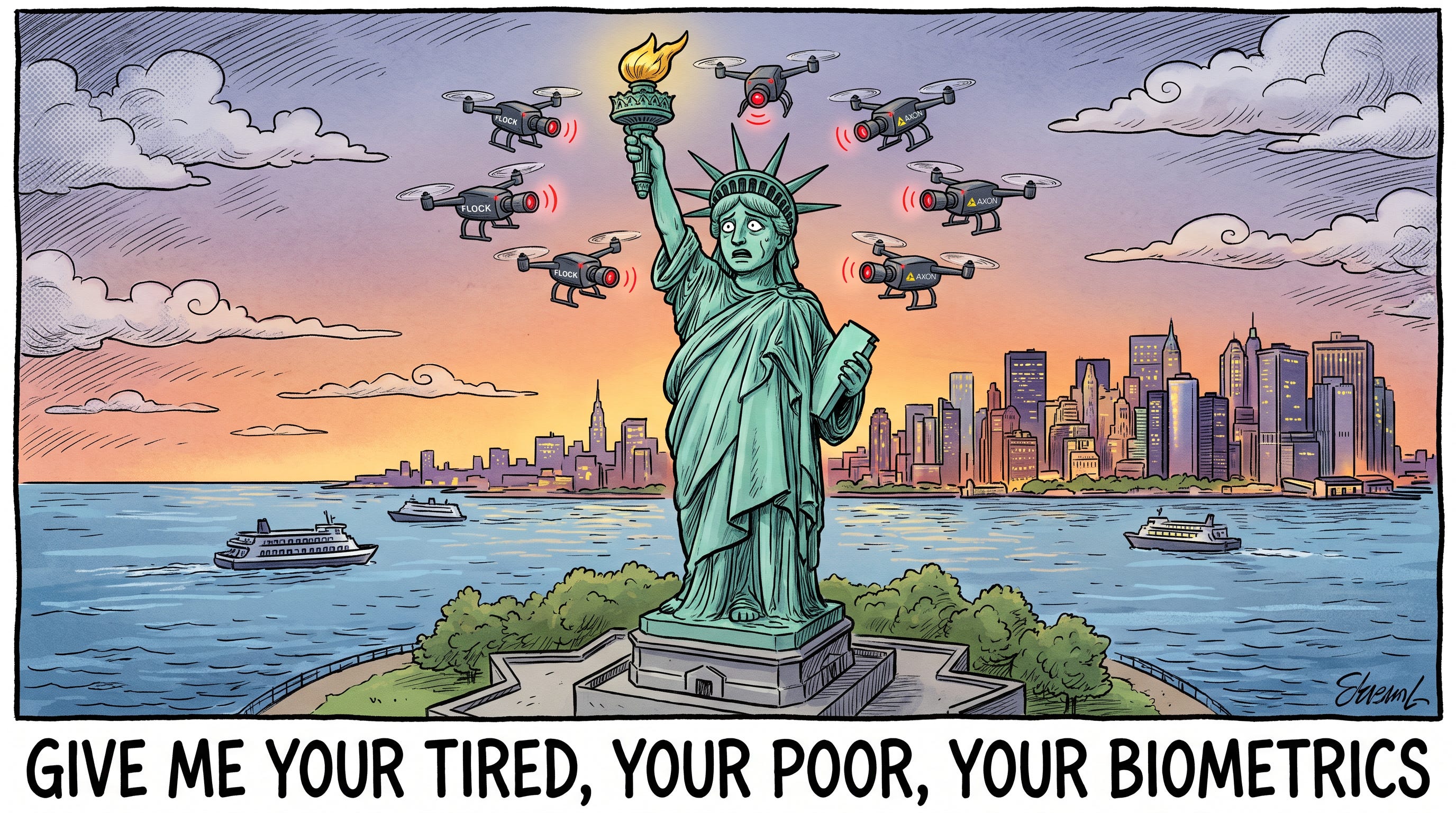
And it is not one company. This is the part the industry would prefer you never assemble into a single picture. Motorola Solutions — a name that still carries the harmless whiff of walkie-talkies and dispatch radios — spent $445 million in 2019 acquiring VaaS International Holdings, parent of Vigilant Solutions, which runs its own national plate-reader network for police, and of Digital Recognition Network, which runs the identical apparatus on behalf of repo men and debt collectors. Bundled into the purchase, as it always is, was facial recognition, because no company in this sector has ever bought a camera network without immediately wondering what else it might be pointed at. Motorola presently holds a $22.8 million contract furnishing this equipment to Immigration and Customs Enforcement’s removal operations. So the next time a spokesman explains to you that these cameras exist to recover abducted children, you are entitled — indeed obliged — to ask why so much of the money is arriving from the agency whose core competency is loading human beings onto airplanes.
Axon, meanwhile, which once merely sold the Taser and now sells what it calls an “ecosystem,” managed the singular distinction of having its own paid AI ethics board resign en masse in 2022 rather than endorse the company’s announced intention to fly Taser-armed drones over American crowds. Consider the comedy of that: a panel of ethicists, hired by the company, compensated by the company, convened precisely to furnish the company with the appearance of conscience — and they walked out, because the plan was too grotesque even for a body whose entire function was to be agreeable about it. The same company had earlier banned facial recognition on its body cameras after concluding the technology was not reliable enough to use on human beings; it is now testing that same technology against a Canadian city’s “watch list” of faces, a phrase I would ask you to roll around on the tongue slowly, and to consider what watch lists have historically been for, and whose faces have historically been on them.
Three companies, one organism. The radios, the cameras, the Tasers, the drones, the dispatch software, the facial recognition, the deportation contracts — all fused now into a single commercial beast with one shared metabolic requirement: more cameras, longer retention, deeper queries, higher renewal fees. Flock merely got there faster. Motorola and Axon are racing it toward the identical finish line, which is a country in which no vehicle moves and no face passes a lens without being logged, matched, and served up to whichever agency has the budget.
And if you require proof of what such an apparatus does the moment a government declares an emergency, you need not speculate, because we have already held the dress rehearsal and most of you applauded it. In 2020, Rhode Island state troopers stood by the highway hunting New York plates with their own eyes. Drones patrolled beaches scanning for sunbathers. Vaccine passport systems gated entry to restaurants on the strength of a state-verified medical status. Every one of those measures was throttled by one thing only — human labor. A trooper’s eyeballs, an operator’s thumb, a bouncer’s attention span. Now graft that same emergency instinct onto a network that automatically flags every out-of-state plate crossing a county line, every car idling outside a church service held in defiance of a gathering order, every vehicle parked at a protest — and I would remind the smug on both wings that the technology is magnificently nonpartisan about whose protest it records. The restrictions of 2020 expired because the machinery to make them permanent had not yet been installed. It is installed now. It went up while you were being reasonable about a traffic camera.
I anticipate the objection, as one always must: if you have nothing to hide, you have nothing to fear. I would like this sentence taken out behind the building and shot. It fails before it even reaches the moral argument, on the plain facts of the Tulsa case: the deputy did not query that system because he suspected narcotics. He queried it because of a license plate design shared by some thirty million entirely innocent people. The system drew no distinction between a trafficker and a grandmother driving home from her son’s wedding, because it is structurally incapable of drawing one. That is not a defect awaiting a software patch. That is the architecture performing exactly as specified. “Nothing to hide” is no defense against a machine that never asked the question in the first place, and merely recorded you against the possibility that someone, someday, for some reason not yet invented, might care to look.
The public safety argument deserves one honest paragraph, and shall have it. Yes, these systems recover stolen cars. Yes, they occasionally intercept something genuinely monstrous. I dispute none of the anecdotes; I dispute the leap from this sometimes works to therefore the Fourth Amendment is suspended for everyone who has ever owned a vehicle. A kitchen knife also stops the occasional intruder. We do not conclude from this that every household must leave one unregistered in the hands of whichever stranger is nearest the counter. Blanket surveillance catches criminals in precisely the way that carpet-bombing a city kills combatants — efficiently, indiscriminately, and at a cost that no serious person would accept if asked to state it out loud.
So I have no interest whatever in the reform agenda, and I would ask you to be suspicious of anyone who offers you one. Retention limits. Audit logs. Warrant requirements. Oversight boards. Every one of these is a mechanism for negotiating the terms of your own surveillance, and every one of them is written by people whose revenue depends on the surveillance continuing. You do not regulate a shark into vegetarianism. You remove it from the water.
Make it illegal. Not “better governed” — illegal, as a criminal matter, in statute, with penalties attached to executives rather than fines absorbed as a cost of doing business. Prohibit the operation of persistent, networked, location-tracking camera systems by any government agency or private contractor serving one. Prohibit the retention and resale of bulk vehicle-location data outright, which disposes of the repo-man subsidiary along with the police one. Prohibit facial recognition deployed against the general public by law enforcement, full stop, before the “pilot program” completes its traditional metamorphosis into permanent policy. Void every existing contract. Order the hardware removed — not deactivated, removed, as Cambridge, Massachusetts discovered was necessary when Flock reportedly reinstalled two cameras after the city had already torn its system out and declined to be surveilled further. There is your industry’s attitude toward democratic consent, demonstrated in the field: your city council’s vote is an obstacle to be routed around, and in Millcreek, Utah, a Flock camera simply materialized on public property that neither the city nor its police department could account for. A company that installs surveillance equipment on land belonging to a government that told it no is not a vendor in a contractual dispute. It is a trespasser with a subscription model, and it should be treated by prosecutors accordingly.
None of this is a left-right question, and I am past patience with those who pretend otherwise. It is genuinely preposterous that there exist Americans who howl about government overreach at the prospect of a tax audit and fall silent while a private firm logs their movements forty times a week, and equally preposterous that there exist Americans who denounce unchecked police power and then defend the identical infrastructure the instant it is rebranded a “community safety partnership.” Both of you are being played by the same salesman, who does not care which of your slogans he has to recite to close the deal.
Orwell gave us the image of a boot stamping on a human face, forever, and we have spent eighty years congratulating ourselves on having avoided it. We have avoided nothing. We have merely bought the superior model, in which no stamping is required, because the face has already been catalogued, the car has already been tracked, the route has already been archived, and the citizen has already been persuaded that objecting would be impolite. The boot is optional when the lens is universal. That is the upgrade, and we paid for it ourselves.
If the argument for Flock’s camera network is genuinely “it makes us safer,” then I confess I cannot locate the principled place to stop. Neither can its advocates. They have simply not yet been asked the question with sufficient persistence. An ankle bracelet would make us safer still. It is continuous and portable. It does not require waiting for a car to pass a pole. We already strap them onto people merely accused of crimes without a flicker of public objection. The principle is evidently not an alien one. It has simply not yet been generalized to the law-abiding majority. They too would presumably benefit from being located at all times for their own good by people who care about them deeply and bill the county quarterly.
Once we have conceded that safety trumps the inconvenience of being a free person with an interior life unknown to the state, I see no serious argument against the chip in the palm. Subcutaneous. Tamper-proof. Scannable at every door, every register and every checkpoint. It spares us even the tedium of carrying a wallet or the small risk of losing a bracelet in the surf.
The Book of Revelation is a text I otherwise regard as a fever dream committed to parchment by a man who had eaten something regrettable on Patmos. It nonetheless had the good sense to identify exactly where this road terminates: a mark in the hand without which no man might buy or sell. We have simply arrived at the same destination by a duller route. Not through the Beast and his number but through a sales rep from Flock with a slide deck and a line item marked “public safety.” That phrase turns out on inspection to be a euphemism with considerably more stamina than the apocalypse that inspired it.
We could call the implant “TRUST” “Transactional Registry for Unified Services and Tracking”
In fact, I already did that in my novel: Mia.
Grab that here: https://www.amazon.com/dp/B0H8CSR1KV