
There is a particular species of moral panic that recurs with tedious regularity throughout human history. We build a tool to reduce labor, expand access, or amplify ability, and then immediately construct an elaborate moral architecture to ensure that using it remains the exclusive privilege of those already positioned to benefit from the status quo.
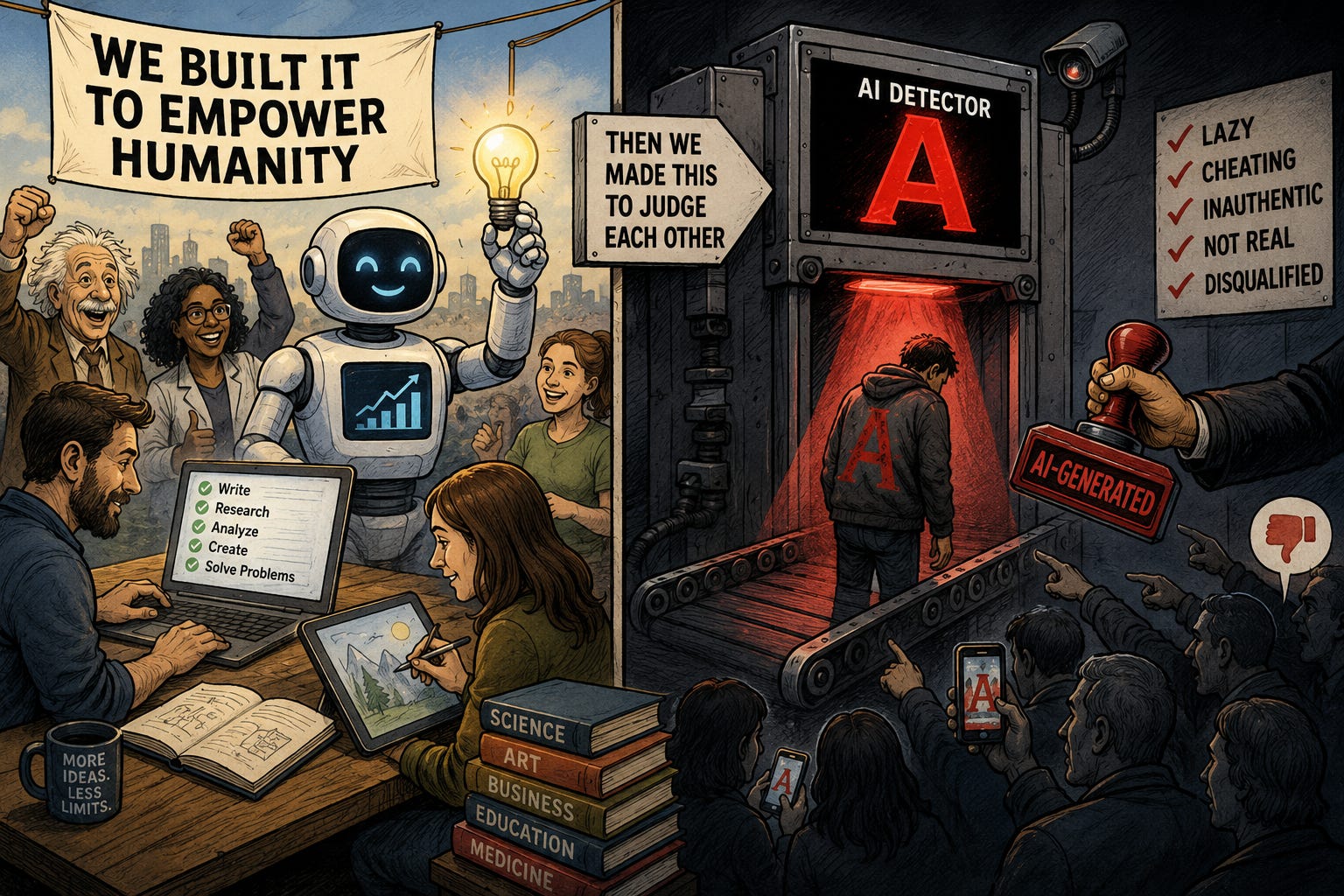
Artificial intelligence represents merely the latest chapter in this ignoble history of technological gatekeeping. What makes the current hysteria especially grotesque is its profound hypocrisy: society pours billions into developing and integrating AI into every conceivable industry while simultaneously manufacturing sophisticated systems of detection, shame, and punishment aimed at those who actually dare to use it.
We have created the most powerful intellectual amplifier in human history, only to immediately begin constructing a digital scarlet letter system to brand those who employ it as frauds, cheats, and moral degenerates. The technology is hailed as revolutionary when corporations use it to automate jobs or when governments deploy it for surveillance, but becomes suspiciously corrupt when an individual writer, researcher, or student employs it to overcome limitations or enhance their work.
This is not an ethical framework; it is a superstition dressed as one—a new form of Luddism for the information age, dressed in the respectable garments of academic integrity and creative authenticity. Like all such moral panics, it serves primarily to protect existing hierarchies by transforming a neutral tool into a character judgment. The technology is detected, and the user is presumed lazy. The machine participated, therefore the human contribution is treated as fraudulent. No investigation of the actual process is required.
The problem begins when a statistical classification is treated as a moral verdict. An AI detector cannot see the creative process. It cannot know whether someone entered a careless prompt and published the first response or spent days questioning, editing, reorganizing, and rewriting the result. It cannot measure intention, knowledge, taste, judgment, persistence, or responsibility. It recognizes patterns and assigns probabilities. That is all.
Consider two people using the same technology. The first person asks an AI system to produce an article about a subject they barely understand. They accept the initial response, verify nothing, contribute no original thought, and publish it under their name. The second person begins with a developed argument, supplies evidence, challenges weak reasoning, rejects generic language, corrects factual errors, rewrites entire sections, and assumes responsibility for every statement in the finished work.
Both pieces may be described as AI-assisted. That description conceals more than it reveals. One person used AI to simulate thought. The other used it to extend thought. One surrendered judgment. The other exercised it continuously. Treating those processes as morally identical is like claiming that every photograph produced with a camera represents the same degree of artistic involvement.
The romantic image of creation is a solitary figure confronting a blank page and summoning complete sentences from an untouched interior world. It is a compelling image. It is also mostly fiction. Writers use editors, researchers, dictionaries, thesauruses, style guides, search engines, transcription software, beta readers, workshops, and the accumulated influence of everything they have ever read.
The arrival of AI threatens more than jobs. It threatens identities built around scarcity. Many professional skills have value partly because they require years of training, expensive education, institutional access, or significant free time. AI does not eliminate expertise, but it can lower the entrance barrier to certain parts of the work.
The distinction is not always about artistic integrity. Sometimes it is about who was permitted to purchase human assistance before machines made a version of it widely available. The moral panic around AI is, in many cases, simply status anxiety dressed in the respectable language of ethical concern.
The problem is not that a machine was involved. The problem is that a human being used the machine to avoid accountability while claiming credit. That distinction matters because the opposite is also possible. A person may use AI extensively while remaining responsible for the ideas, decisions, accuracy, and final form of the work. The technology performs labor, but the human retains command.
Assistance becomes abdication only when judgment disappears. A power tool does not make someone a craftsman, but using one does not disqualify the craftsman either. We still inspect the joints, test the structure, and ask whether the person understood what they were building. We should apply at least the same intelligence to creative and intellectual work. These articles are my thoughts, my discipline, my responsibility to get it right. It’s me putting in the long hours in spite of the help. I do the thinking, research, decisions, and rewriting. AI helps organize and polish the language, but the substance, judgment, and final work are mine. This is NOT: Give prompt, publish bullshit.
So I say embrace this technology, but use it responsibly. The work, in the end, should be evident and should speak for itself.