

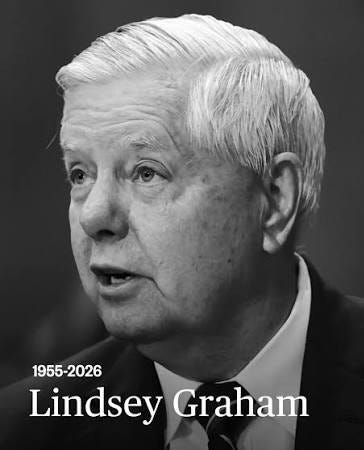
So, the grim reaper has finally claimed Lindsey Graham, who has departed this mortal coil after what his office delicately terms a “brief and sudden illness.” One imagines his conscience, long neglected and atrophied from disuse, simply gave up the ghost entirely. At 71, he leaves behind a legacy of such breathtaking political opportunism that it makes one wonder if he ever possessed a spine at all, or merely rented one when cameras were present.
The timing, of course, is rich with irony. This tireless champion of sending others to fight and die in foreign lands, one of Washington’s most reliable hawks who had just returned from yet another jaunt to Ukraine to posture with Zelenskyy, was apparently felled not by an enemy combatant but by the mundane betrayal of his own circulatory system. Emergency services, we’re told, were summoned for “chest pains,” that most democratic of ailments, which cares nothing for one’s standing on the Senate Budget Committee or one’s proximity to presidential power.
Graham’s political career serves as a masterclass in the art of the sycophant. Having once correctly identified Donald Trump as a “race-baiting, xenophobic, religious bigot,” he subsequently performed such a remarkable reversal that one suspects he suffered from political whiplash. He transformed himself from a critic into the most slavish of lickspittles, a man whose principles could be packed into a thimble with room to spare, all for the privilege of proximity to power. His devotion was less to country than to the current occupant of the Oval Office, a fact that even the most casual observer could discern without difficulty.
But let us not mistake him for a mere opportunist. Graham was an active agent of misery, a man whose legislative fingerprints could be found on some of the most repugnant policies of our time. Here was a man who devoted his energy to ensuring that the sick and the poor would remain without adequate healthcare, voting repeatedly to dismantle the Affordable Care Act without ever offering a coherent alternative, preferring instead to see Americans suffer and die from lack of insurance. He championed tax cuts for the wealthiest while preaching fiscal responsibility, a hypocrisy so blatant it would make a televangelist blush.
His foreign policy was a festival of death, a relentless cheerleading for American military power deployed not for defense but for domination. Graham salivated at the prospect of conflict with Iran, advocated for bombing Syria into oblivion, and treated the Middle East as his personal chessboard where other people’s lives were the pawns. He was Israel’s most ardent American defender, not out of principle but out of political calculation, defending every atrocity, every settlement, every disproportionate response with the enthusiasm of a true believer who had found his religion in militarism.
The tributes, naturally, have been as predictable as they are nauseating. Trump, that arbiter of all things great and true, declared him “one of the greatest people and Senators I have ever known,” a judgment that speaks volumes about the company Trump keeps. Netanyahu mourned him as “one of Israel’s greatest friends,” which is to say he was an American senator who put the interests of a foreign nation ahead of his own with alarming regularity. And Zelenskyy, grateful for Graham’s advocacy for more American money and weapons, praised him as a “true defender of freedom,” that elastic term so often deployed to justify endless military entanglements.
What remains of Graham’s political capital has been spent, his legacy secured not through any meaningful legislation or principled stand, but through his unwavering fealty to the powerful. He will be remembered not as a statesman, but as a functionary, a man who knew the price of everything and the value of nothing. The world is indeed better off with one fewer war hawk, one fewer voice eager to dispatch young Americans to die in conflicts that serve only to enrich the military-industrial complex he so faithfully represented.
His sudden departure from the political stage, scheduled as he was to appear on “Meet the Press” the very next day, leaves a vacancy that will, one hopes, be filled by someone with at least a passing acquaintance with integrity. But in the swamp of Washington, such hopes are often dashed. Still, for today at least, we can take small comfort in the fact that Lindsey Graham’s capacity for advocating war has been permanently retired. The brief and sudden nature of his passing seems almost fitting, given the brief and sudden nature of his convictions.
The polemic is earned, and those of his ilk witnessing such fitting eulogies such as mine, take note: Your own eulogies will be similar. That is the legacy you chose to leave. Good riddance.