
Let us dispense with the tedious preamble about rot and decay. What we are witnessing is not a decline but an unveiling—a stripping away of the last pretenses that separate a republic from a protection racket. The state is no longer a public trust; it is a hostile asset to be seized, liquidated, and its proceeds distributed among the loyal. This vulgar transformation was not merely accelerated but sanctified by the Supreme Court’s 2024 ruling in Trump v. United States, an act of judicial abdication that created what the Brennan Center, with characteristic understatement, calls “a zone of lawlessness around the Oval Office.”
The Court’s decision, a masterpiece of intellectual sophistry, established that presidents have absolute immunity for core constitutional powers and presumptive immunity for official acts. As Justice Sotomayor warned in her dissent, this ruling effectively means a president could “take a bribe in exchange for a pardon” and remain immune from prosecution. The ruling has since been weaponized to shield corruption from accountability, with The New Republic noting that with “the gift of immunity from the Supreme Court, he spent the first year of his second term taking bigger swings at double-dealing, committing more brazen acts of corruption.”
The consequences of this legal architecture have manifested in patterns of self-dealing so flagrant they would make a Third World dictator blush with envy. Consider the case of cryptocurrency entrepreneur Justin Sun, who faced SEC charges for selling unregistered crypto securities in 2023. After Trump’s 2024 election victory, Sun conveniently purchased $30 million of WLF tokens, and upon Trump taking office, the SEC suddenly paused its enforcement action against him. Similarly, Trump’s pardon of CZ (Changpeng Zhao) of Binance—despite CZ having already served his four-month sentence for money laundering violations—was followed by Binance generating millions in profits for Trump through transactions with companies linked to his family.
Perhaps most revealing is the Justice Department’s April 2025 attempt to dismiss public corruption charges against New York City Mayor Eric Adams. The DOJ argued that Mayor Adams could not assist with Trump’s aggressive immigration enforcement agenda while under indictment—essentially trading the dismissal of legitimate corruption charges for political cooperation. This mirrors the administration’s approach to foreign policy, which has become what one South Korean crypto executive attending a private dinner called “kind of a fund-raiser,” noting that Trump will “always be good to his sponsors.”
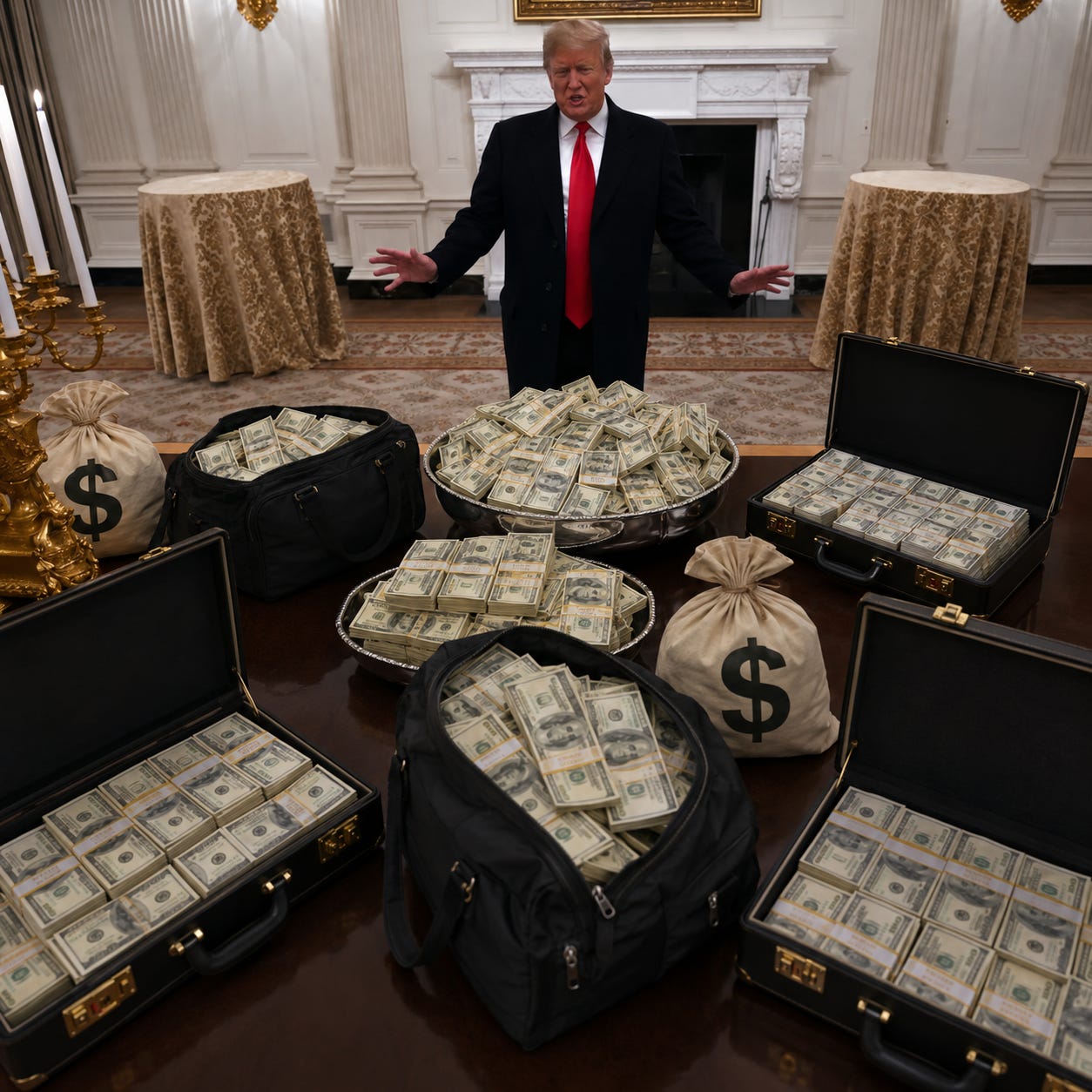
The financial consequences of this corruption have been staggering. According to his financial-disclosure report, Trump netted $2.2 billion in just his first year back in office—nearly quadruple the year before. This windfall comes as the Supreme Court continues adding to Trump’s bank of powers, creating a feedback loop where legal immunity enables financial enrichment, which in turn funds further efforts to expand presidential authority.
The Trump administration has perfected the art of transforming every accusation into proof of its own righteousness. When investigated, they claim martyrdom; when questioned, they wrap themselves in patriotism; when exposed, they play the victim. This moral alchemy allows them to present corruption as success, conflicts of interest as business as usual, and the use of state power as personal insurance as “correction of prior injustice.”
The fundamental problem is that Trumpism is not conservatism, which at least theoretically reveres institutions and restraint. Nor is it populism, which claims to defend the people against entrenched privilege. Instead, it is appetite dressed as ideology, grievance with a procurement department—the politics of a man who treats the nation as a hotel, the courts as security, the cabinet as management, and the voters as guests to be billed for damages. The factory worker gets the speech, the donor gets the policy, the son gets the opportunity, the lawyer gets the appointment, and the taxpayer gets the invoice.
This corruption has been further enabled by recent Supreme Court decisions that have significantly narrowed the federal bribery statute, making it difficult to prosecute public corruption outside of directly provable quid pro quo exchanges of political favor for something of value. If there were ever a prosecution related to President Trump’s unofficial acts related to $TRUMP coin investors, there would be a presumption that his official acts could not be used as evidence of corruption.
The Court’s 2025-2026 term has been dominated by cases related to President Trump, with the justices delivering mixed results—upholding birthright citizenship while allowing states to bar transgender athletes from participating in women’s sports, and ruling that Trump cannot continue with most of his sweeping tariffs. However, these limited constraints do little to address the fundamental corruption enabled by the presidential immunity ruling.
A country cannot sustain this arrangement indefinitely. Institutions hollowed out for one man do not magically refill themselves. Laws bent for one family do not straighten on command. Public trust, once converted into a casino chip, is not easily redeemed. The scandal of Trumpism is not that it brought corruption to Washington—Washington required no tutor in that subject—but that it removed corruption’s embarrassment, liberated it from shame, and taught the crook to stop lowering his voice.
The answer to such a state is not faint concern but exposure, investigation, removal, and prosecution where crimes are proved. It requires making them answer for the tax protections, the family deals, the oil-market coincidences, the defense contracts, and the use of state power as personal insurance. It demands retiring the soft vocabulary of “norm-breaking” and “controversial” in favor of calling the thing by its name: corruption with bad syntax and worse hair, the old American disease of money worship swollen into dynastic entitlement.
The true tragedy is not that such corruption exists—it has always existed in human affairs—but that it has been so brazenly normalized, so shamelessly celebrated, so thoroughly integrated into the machinery of state that a substantial portion of the population has been convinced to cheer for their own fleecing. When the grift becomes the governing philosophy, when corruption is rebranded as patriotism, when the plundering of the public trust is presented as an act of liberation, then the republic is not merely in danger—it has already been hollowed out from within, leaving only the hollow shell of democratic rhetoric to conceal the rot within.
What we are witnessing is not merely corruption but the complete inversion of the social contract. The state is no longer an instrument of collective will but a private instrument for personal vengeance and enrichment. The Constitution has become a menu of options rather than a set of constraints, and the highest office in the land has been transformed into the most lucrative protection racket in human history. When the President can take bribes with impunity, when the Justice Department can be traded for political cooperation, when foreign policy becomes a commodities market with missile trails, then we are no longer discussing politics but predation—systematized, legalized, and celebrated by those who benefit from it.
The ultimate horror is not that such things happen but that they happen so openly, so shamelessly, with such contempt for the very notion of public service. The grift is no longer hidden in shadowy backroom deals but announced from press rooms with flag backdrops and the familiar damp sheen of men who have mistaken immunity for innocence. This is not the decay of the republic but its transformation into something else entirely—a hollowed-out shell operated by grifters, for grifters, with the silent complicity of those too cowardly to call it by its name.