
They spent a year hiding their faces. Now the public has the org chart.
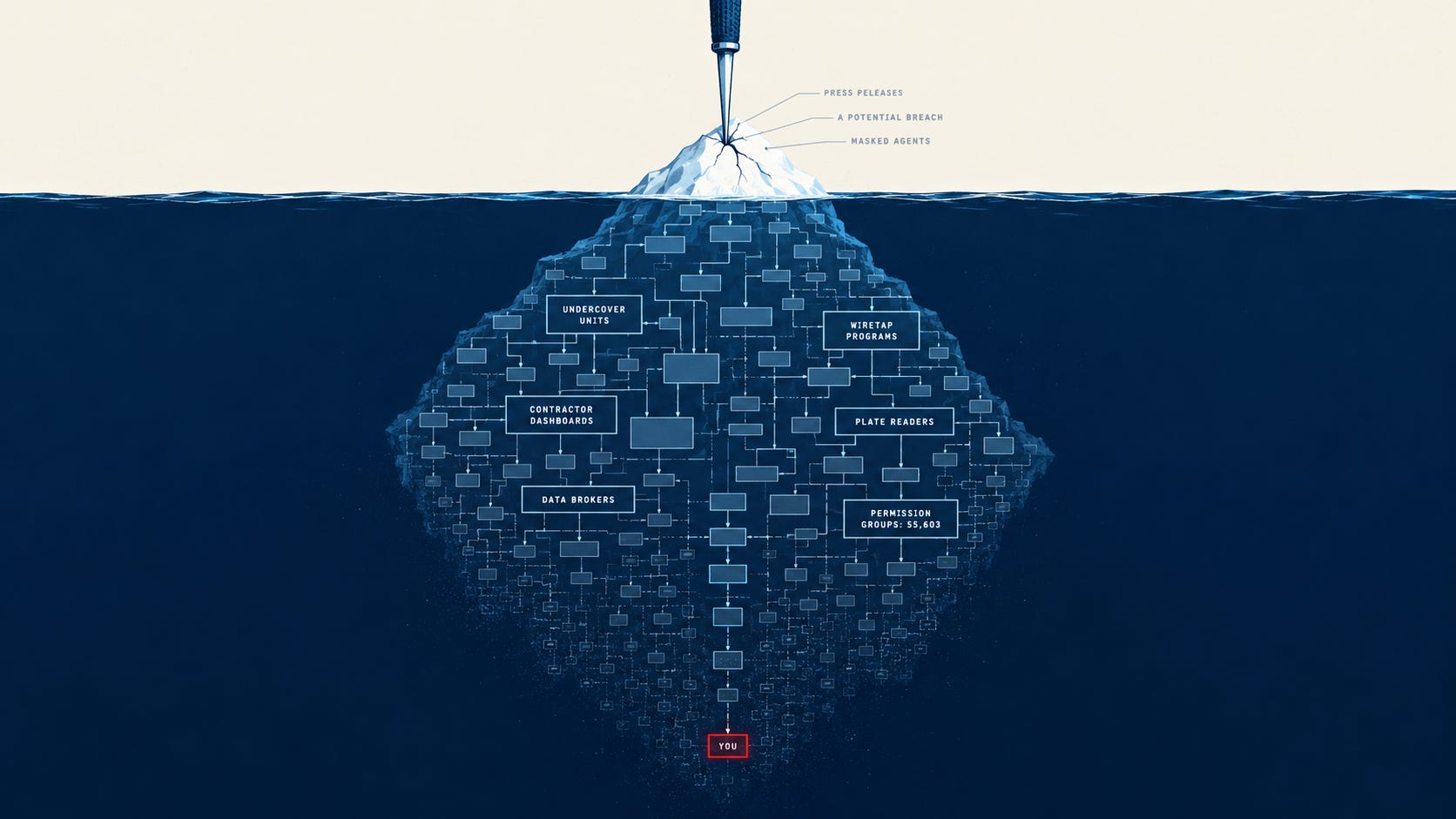
On Wednesday a transparency collective called Distributed Denial of Secrets posted a searchable database it had named, with a certain gallows wit, “Icepick.” Inside were 41,191 personnel records from the Department of Homeland Security and its seven component agencies: names, phone numbers, work emails, supervisor chains, and better than 55,000 internal permission groups whose labels read like a parts catalogue for the surveillance state. Undercover units. Wiretap programs. The contractor dashboards. The hackers, who style themselves the Department of Peace, say they strolled in through Okta, the single sign-on service that was supposed to be the front door’s deadbolt. WIRED broke the story. The Washington Post confirmed it. DHS announced it was “aware of a potential breach,” which is how a man confirms a fistfight by bleeding on you.
Now for the part a polemicist is contractually obliged to say, and which I happen to mean. Publishing the cell numbers of undercover agents, and by extension the addresses of their children, is the work of thugs. A person who takes a government job is owed the ordinary decencies, and “undercover” is a door the public has agreed not to kick in. I will not pretend otherwise merely because the victims are unlovely. But hold the two facts in your head at once, since the people who run DHS evidently cannot: the leak exposed the men, and it exposed the machine, and the machine was the scandal all along. What we now possess, by courtesy of some very skilled vandals, is a wiring diagram of a domestic surveillance apparatus that was never presented to the public in plain language, never voted on as such, and never consented to by anyone outside a classified briefing room.
Nor is this the first delivery. There was “ICE List,” run from a server in the Netherlands. There was the gang calling itself The Com, which dumped 680 DHS employees and then asked its Telegram followers whether they’d like the IRS next. There was the contract trove, 6,000 companies deep, naming Palantir, Anduril, Microsoft and Oracle as the quartermasters of the deportation machine. Notice the pattern, because it is the whole argument. The only audits this apparatus ever receives are conducted by criminals. A secret court blesses secret programs under secret readings of the law; a contractor builds the index; a data broker sells the location trail that the Fourth Amendment was meant to make expensive. The public learns any of it only when a whistle-blower risks prison or a hacker risks indictment. Consent extracted from people kept in the dark is not consent.
Consider how the courts have handled this, if “handled” is the word for a man who waves a freight train through a level crossing. In 1983 the Supreme Court ruled that a suspect had no privacy interest in his movements on a public road, a holding written about a single radio beeper taped inside a drum of chloroform. That opinion is now asked to bless a permanent, national, searchable index of every car in America. The same Court spent the 2010s dismantling precisely this logic, in Jones and then in Carpenter, holding that the aggregation of a citizen’s movements is itself a search. The lower courts, and the camera companies, have simply pretended not to hear.
You will have noticed the cameras, if you drive anywhere at all: small white boxes blooming on the light poles like lichen. Flock Safety has wired more than 5,000 police agencies into one database that logs every plate that passes and keeps it, by default, for thirty days. Where you went to the mosque, the oncologist, the protest, the ex-wife’s street, in what order and at what hour. No crime need be suspected, no warrant sought. In May the FBI went shopping for up to $36 million worth of nationwide plate-reader access, warrants not included. And in Lufkin, Texas, a single police officer was indicted this year on a hundred felony counts after running the system more than 45,000 times in roughly 200 days, one plate nearly 3,500 times. Nobody noticed for seven months. That is worth dwelling on. The system did not fail. The system worked exactly as sold, and it took a grand jury to discover what it had been sold for.
The apologists have one hymn and they sing it flat: if you’ve done nothing wrong, you’ve nothing to fear. One scarcely knows where to begin with a proposition so lazily totalitarian, except to observe that it has never been uttered by anyone who has read a history book or opened a letter from their bank’s fraud department. The Netherlands kept the most meticulous civil registry in prewar Europe, religion neatly recorded, all perfectly innocent, and when the occupiers arrived they found the deportation lists already typed. Dutch Jews died at three times the rate of French ones. The House Un-American Activities Committee also believed its filing cabinets were neutral. A dossier on every citizen is not a tool that waits politely to be abused. It is the abuse, idling, until the right administration or the right panic or the right man with the right grudge turns the key. That fat bastard again.
The counter-argument with better manners deserves an answer rather than a sneer, because it is partly true: there are real threats, and surveillance has caught real killers. But look at what it actually defends. Nobody serious proposes that the state be forbidden to get a warrant and tap the phone of a specific suspect. That is ordinary policing, older than the automobile, and it requires exactly the machinery the dragnet skips: probable cause, particularity, and a judge who signs his own name. The dragnet’s defenders are not defending the capture of criminals. They are defending the convenience of not bothering with the Constitution, a convenience for which the taxpayer pays Palantir and its cousins billions a year. It is the most expensive shortcut in the history of the republic.
And here, for once, is a political question where the coalition assembles itself without anyone sending invitations. The civil libertarian who watched the cameras track a protest. The gun owner who never did trust the alphabet agencies. The reporter whose source was burned. The churchgoer who found her plate in a records dispute over an abortion clinic. Ron Wyden has spent two decades on this hill; Ron DeSantis, not a man one associates with the ACLU, said in September that the public is “right to be concerned” about Flock-style surveillance and is looking at safeguards. These tribes agree on nothing else, and they arrived at the same room by different doors, because the logic admits no exceptions: whatever surveillance power exists will eventually be aimed at whoever the people holding it dislike. The only surveillance state that never turns on you is the one that was never built.
The present administration earns particular scorn here, having ridden to office on a loud distrust of the “deep state” and then fed that state until it could barely waddle: more ICE money, more Palantir, more cameras, and agents in masks on American streets. You cannot campaign against the surveillance apparatus by day and renew its purchase orders by night, and you certainly cannot demand anonymity for your own men while buying the end of everyone else’s. The Icepick hackers did not invent the principle that anonymity is not a one-way privilege. They merely enforced it, crudely, after the government declined to.
Section 702, the statute under which the NSA hoovers up foreign communications and the FBI then rummages through the American ones caught in the net, lapsed on June 12 for the first time in its history, after Congress could not stomach the thought of handing the keys to an acting intelligence director best known for his social media feuds. Collection carries on under existing court certifications until March 2027. That is the window. Any revival must carry a warrant requirement before an American’s communications may be queried, full stop. Pass the Fourth Amendment Is Not For Sale Act, which the House already approved once, so that agencies can no longer buy from a broker what the Constitution forbids them to seize.
Or start smaller, which is to say start where you can actually win. The Flock camera is the most vulnerable organ in the entire apparatus, because unlike a data center in Utah it has a city council, a budget line, and a public comment period. By one tally more than a hundred towns and counties have cancelled, rejected or unplugged their networks since January, and the pace is accelerating. Show up once. File one records request. Ask one question at the microphone: who else can search this, and how would we know? The thing was built on the assumption that nobody would ask.
The Icepick database will be scrubbed, mirrored, litigated and forgotten. The question it opened will not close so easily. A free society and a surveilled one are not two settings on the same dial; they are opposite ends of it, and every server rack purchased in your name tilts the needle. The governed have finally seen the playbook. What remains is to decide whether consent was ever the point, or merely the alibi.