


There is a particular species of fraud that does not merely deceive others but first deceives itself. Jeremy Dewitte, the Florida funeral escort operator who spent two decades cosplaying as a police officer while recording his own crimes on body camera, belongs to this genus of self-incriminating narcissist. You will have noticed, dear reader, that most criminals attempt to obscure their misdeeds. Dewitte, by contrast, accumulated nearly a terabyte of self-documented evidence—a digital autobiography of delusion so comprehensive it could serve as a doctoral thesis on the psychology of control.
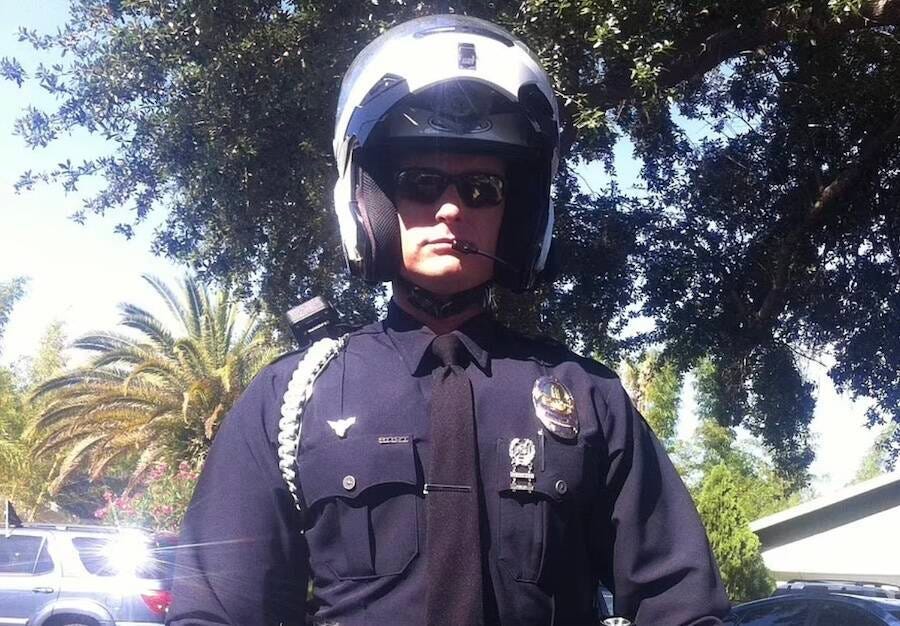
The mechanics of his particular theater are almost too absurd to recount without laughter. Here was a man who dressed in police-style uniforms, affixed emergency lights to his motorcycles, and directed traffic with the performative gravitas of a community theater actor given too much encouragement. His company, Metro State Vehicle Protection Services, provided funeral escorts with all the militarized pomp of a presidential motorcade. When actual law enforcement officers stopped him—something that happened with the predictable regularity of a metronome—Dewitte would insist he was a “special agent” and demand to speak with a supervisor. The audacity would be almost admirable were it not so pathologically persistent.
But the costume was never the point. The uniform, the lights, the barked commands at civilians—these were merely the external manifestations of an internal rot. What Dewitte truly craved, what he purchased with every illegally installed siren and every fabricated credential, was the intoxicating sensation of dominion over others. The control freak does not seek power to accomplish things; he seeks power to feel the texture of obedience, to watch others yield, to experience the narcotic of manufactured authority.
You will find this same pathology in the leaked jailhouse phone calls, those exquisite recordings that capture Dewitte toggling between his wife Rania and his mistress Jennifer with the emotional dexterity of a sociopath. To one: “I love you, you’re my world.” To the other: “I love you babe! I only want you.” The words are interchangeable because the sentiment is counterfeit. What appears to be romantic devotion is merely another form of control—two women managed, manipulated, kept in orbit through the centrifugal force of deception. He tracked his wife’s phone to prevent her discovery of his affairs, then used that same surveillance infrastructure to coordinate his duplicity. The architecture of control, once erected, serves multiple masters.
Dewitte’s curriculum vitae of misconduct would fill a modest filing cabinet. A 2005 conviction for sexual battery on a child between the ages of twelve and fifteen. More than a dozen arrests for police impersonation dating back to 1998. Insurance fraud. False tax returns. Failure to register vehicles as required of sex offenders. By November 2024, the accumulated weight of his criminality finally collapsed upon him: nearly seven years in state prison for registration violations, followed by 41 months in federal custody for tax fraud, topped with another five and a half years for insurance fraud. The sentences stack like cordwood.
What makes this case singularly grotesque is not the criminality itself but the documentary compulsion that accompanied it. Dewitte wore body cameras not despite their incriminating potential but because of it. He needed to rewatch himself in the act of authority, to relive the moments when civilians yielded to his commands, when real officers were forced to engage with his fabricated persona. The recording was not evidence gathering—it was masturbatory replay, the control freak’s home video collection.
We must ask ourselves what conditions produce such creatures, and more importantly, what conditions allow them to operate for decades before the machinery of justice finally engages. Dewitte’s first arrest for police impersonation occurred when Bill Clinton was still in office. For twenty-six years, he cycled through the system—arrested, charged, released, re-arrested—each time emerging with his delusions intact, his business operational, his capacity for manipulation undiminished. The criminal justice system treated him not as a habitual predator but as a nuisance, a colorful Florida eccentric, until the accumulation of evidence became too voluminous to ignore.
The control freak flourishes in environments where accountability is theoretical and consequences are negotiable. Dewitte discovered early that the trappings of authority—the uniform, the jargon, the confident posture—could substitute for actual legitimacy in a culture increasingly unable to distinguish between performance and substance. We have become, perhaps, too accustomed to the theater of competence, too willing to defer to anyone who wears the costume of command.
There is a remedy for this, though it requires more civic courage than we have recently demonstrated. We might begin by demanding that authority prove itself through demonstrated competence rather than asserted credentials. We might insist that our institutions—law enforcement, regulatory agencies, the courts—treat repeat offenders as precisely that, rather than as perpetual first-time learners. We might cultivate in ourselves the skepticism necessary to question anyone who seems too eager to direct the actions of others, too quick to claim special status, too insistent on deference.
Jeremy Dewitte will spend the better part of the next decade in prison, where the uniforms are issued by the state and the authority is real and unilateral. One imagines him there, still performing for whatever audience he can conjure, still attempting to control the narrative of his own significance. The control freak never reforms; he merely waits for the next opportunity to command. Our task is to ensure that when he emerges—diminished by age, bereft of his costumes, stripped of his surveillance apparatus—he finds a society that has learned to recognize his type: the hollow man who mistakes domination for dignity, and manipulation for love.
If you’re as sick of this as I am, subscribe to Hostile Witness for the deep dives that the mainstream media won’t touch.