

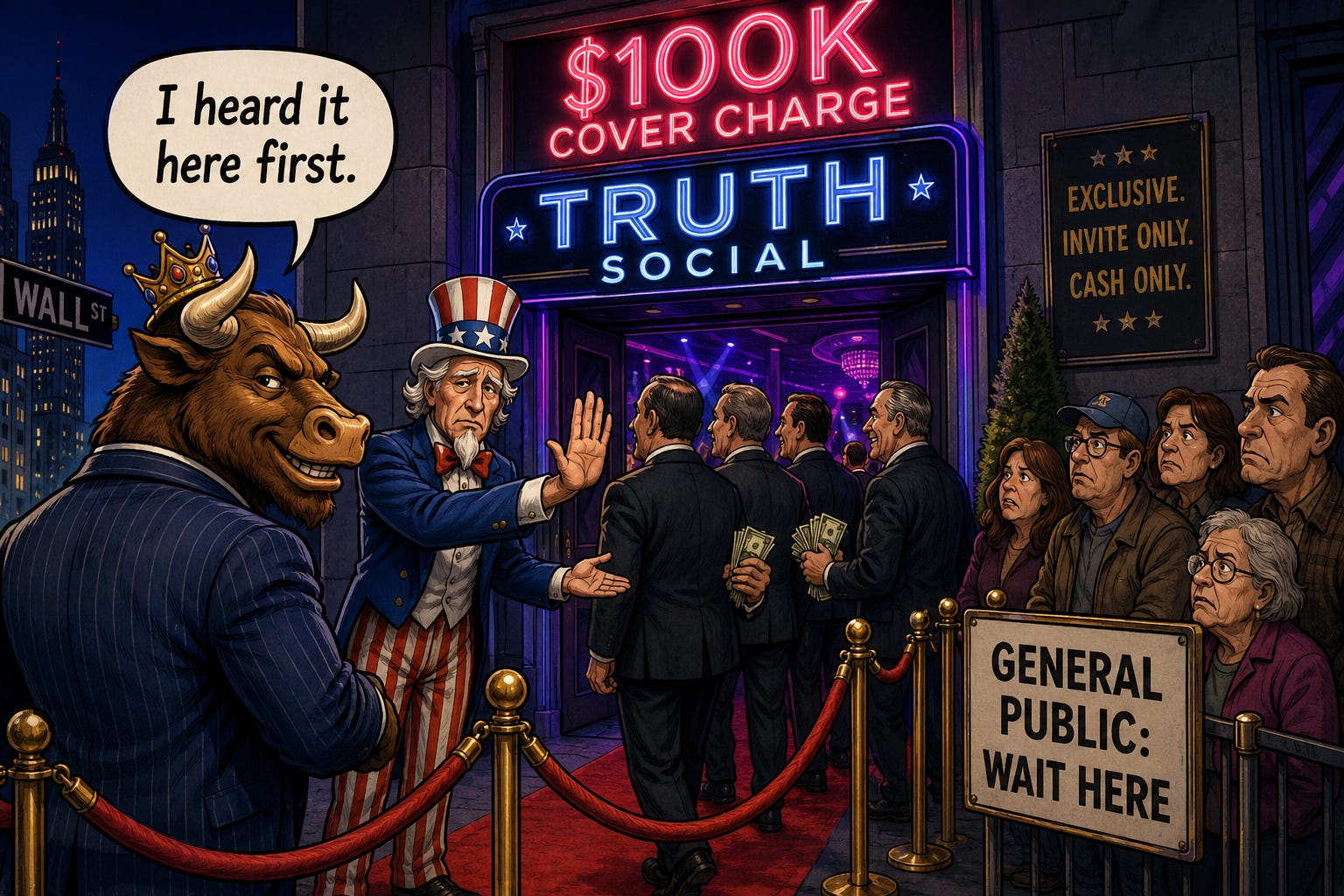
There is a particular strain of American genius, largely untaught in business schools, for finding the one thing nobody has yet figured out how to sell, and selling it anyway. Andrew Carnegie sold steel. John D. Rockefeller sold oil. Donald J. Trump, 47th President of the United States, commander of the nuclear arsenal, and part-time social media personality, has found something even more elemental to peddle: himself, in real time, before you get to hear it.
Beginning August 1, Trump Media & Technology Group — the loss-ridden parent company of Truth Social, in which the President personally controls a trust holding more than 40 percent of the shares — began renting out early access to the President’s own posts. The product is called Truth API. The price is up to $100,000 a month. The customers are hedge funds, high-frequency trading shops, and other institutions whose entire business model is knowing things a few milliseconds before you do. And the product being sold is not information Trump Media generated through investigative labor, market analysis, or any recognizable form of value creation. It is the unfiltered, uncut, occasionally unhinged stream of consciousness of a sitting president, a man whose passing thoughts on tariffs, war, and central bankers routinely detonate across global markets like a dropped chandelier.
Let that sit for a moment, because the sheer audacity of it deserves the full weight of your attention before we move on to the mechanics. The head of state, in whom the public has vested the singular power to move economies with a sentence, has built a subscription service around advance notice of the sentence.
The pitch, as delivered by Trump Media’s interim CEO Kevin McGurn, was refreshingly candid for a scheme this cynical: markets already move on Truth Social posts, so why not get paid for the movement. Truth API promises subscribers the fastest possible delivery of Trump’s posts — some services advertise millisecond-level speed — along with an archive of his posts stretching back to 2022. For a trading firm, milliseconds are not a convenience. They are the entire game. High-frequency traders exist to exploit exactly this kind of gap between when information becomes real and when the rest of the world catches up.
And Trump’s posts are, empirically, the kind of information worth paying for. This is a president who has threatened tariffs on Canada, floated the end of a nuclear agreement with Saudi Arabia, and widened a war with Iran, all via smartphone, all in real time, all with immediate and measurable effects on currencies, bonds, and equities. One trading executive, sizing up the appetite for Truth API, estimated perhaps a hundred high-frequency firms might sign on. Multiply that by $100,000 a month and you begin to see why a company that lost roughly $405 million in a single quarter suddenly discovered religion on the subject of “meaningful, durable revenue.”
This is not a hypothetical harm dreamed up by media critics with a grudge. In April of last year, hours before announcing a 90-day pause on tariffs that sent the S&P 500 up nearly 10 percent in a single session, Trump posted to Truth Social that it was “a great time to buy.” His own company’s stock rose by roughly double the market’s gain that day, adding an estimated $415 million to his personal net worth. Video surfaced of the President in the Oval Office, celebrating with two other men, cheerfully totaling up how many hundreds of millions of dollars they’d each just made. Nobody in that room was surprised the market had moved. They were surprised, if anything, by how much.
Now imagine that same dynamic, except this time a hundred trading desks paid in advance for the privilege of front-running it.
Renée Jones, a former senior SEC official now at Boston College, has laid out the legal theory in the plainest terms available: federal securities law prohibits the misuse of confidential information obtained through a position of trust, and a president selling advance access to statements he alone controls and that move markets on his authority looks, to her eye, like exactly that. It is not a novel argument. It is, if anything, the textbook definition of the offense, dressed up in a subscription tier.
The reaction in Washington has been about as bipartisan as anything gets these days, which is to say Democrats have been loud and specific while a few Republicans have quietly agreed without wanting their names near a press release. Representative Jamie Raskin opened a House Judiciary Committee investigation, demanding Trump Media turn over its customer list, its pricing structure, and its internal communications with the White House. Senators Elizabeth Warren and Adam Schiff wrote to the SEC before the launch, warning that the service would let a wealthy few trade on the President’s opinions before “ordinary investors” ever saw them. Senator Alex Padilla introduced legislation — the Stop Corrupt Trading Act — that would simply ban any president or vice president, or any entity in which they hold a substantial financial stake, from selling advance access to their own official or personal statements. And in a lawsuit filed in the Southern District of New York, The Intercept and the Freedom of the Press Foundation didn’t bother with euphemism, calling the arrangement “extraordinary, corrupt and unconstitutional.”
The SEC itself, one might ask? The same agency charged with policing exactly this kind of misconduct has, under the current administration, seen enforcement actions fall to historic lows, and recently dropped an insider-trading case against a healthcare executive the President had separately pardoned. Asking this SEC to investigate this President for this scheme is roughly like asking the fox to audit the henhouse’s security footage, and finding that the fox has, helpfully, already deleted it.
There is a special, gamey flavor of hypocrisy worth pausing on here, because Hostile Witness would be derelict in its duty if it let this pass unremarked. This is the same president who, during a State of the Union address, demanded that Congress “pass the Stop Insider Trading Act without delay” and used the moment to mock Nancy Pelosi’s stock-trading record in front of a joint session of Congress. Members of both parties stood and applauded the sentiment. It was, briefly, a genuine bipartisan moment — the sort of thing that makes you remember Washington was once capable of agreeing that corruption is bad, actually. Then the man who delivered that applause line went home and, within months, launched a service that makes the Pelosi-era stock trading controversies look like a child’s lemonade stand by comparison. Pelosi, whatever you think of her, was trading on inferences drawn from her position. Trump is trading on the literal, direct, monetized sale of his own forthcoming public statements. If insider trading were a crime of degree rather than kind, this would not be the same offense. It would be the offense’s much richer, much more shameless older brother.
Every good grift needs a respectable-sounding defense, and Trump Media’s spokeswoman has offered one: Truth API, she says, merely provides “the fastest way to ingest publicly available Truth Social data.” This is the sort of sentence lawyers get paid handsomely to construct, and it deserves to be taken seriously before it is taken apart, because on its face it echoes something genuinely legal. Bloomberg terminals exist. Reuters news feeds exist. Firms pay enormous sums for faster access to public filings, faster fiber-optic cables between exchanges, servers physically closer to trading floors so their orders arrive a few nanoseconds sooner. None of that is illegal. Speed is a commodity, and markets have always rewarded those willing to pay for it.
But notice the sleight of hand buried in that comparison. A Bloomberg terminal delivers information generated by companies, governments, and events entirely independent of Bloomberg itself. Bloomberg does not personally decide, in the moment of publication, whether Boeing announces layoffs. It relays. Truth API is a different animal altogether, because the man selling early access to the information is the same man who, alone, decides when to create it, what it says, and — increasingly, it would seem — who gets to profit from knowing it first. The information doesn’t exist until the President decides it should. He is not a wire service. He is the event itself, wearing a wire service as a costume.
This distinction is not academic hairsplitting; it is the entire ballgame. When Trump posts that Iran negotiations have collapsed or that new tariffs are imminent, he is not reporting news. He is making it, in his capacity as head of state, using authority that belongs to the office, not to the man, and certainly not to the private company he happens to control a stake in. Selling faster delivery of a wire report is commerce. Selling faster delivery of your own official pronouncements, made in your capacity as President, to the specific class of people equipped to trade on them within milliseconds, is something else — it is renting out the presidency by the month, with a receipt.
If you want an analogy Hitchens himself might have reached for: this is not a newsstand selling today’s paper an hour early. This is the reporter, the editor, and the subject of the story all being the same person, who has additionally arranged to text the closing paragraph to a select list of subscribers before the presses even start running, for a fee, while insisting with a straight face that this is simply good customer service.
It would be intellectually lazy — and Hostile Witness does not do lazy — to treat this purely as a referendum on one man’s shamelessness, satisfying as that framing is. The deeper rot this episode exposes is structural: the United States has never adequately closed the gap between “things a president knows because he is president” and “things a president is legally forbidden from monetizing because he is president.” The STOCK Act of 2012 addressed congressional trading on non-public information gleaned from committee work. It said nothing about a president auctioning off advance notice of his own market-moving speech. Nobody, in 2012, imagined they needed to. The scheme didn’t exist yet. That is precisely how corruption evolves in a system built on decades-old statutes: it doesn’t break the law so much as it finds the doorway nobody thought to build a wall around.
This is also, worth noting, not really a partisan vulnerability so much as a bipartisan one waiting to be exploited by whoever occupies the office next, of either party. A future president with a media holding, a crypto venture, or simply a friendly hedge fund willing to structure the arrangement more discreetly could run a quieter version of the same play. The particular genius, if you want to call it that, of Truth API is that it launders self-dealing through the language of a tech product. It’s not a bribe; it’s a subscription tier. It’s not insider trading; it’s a data feed. The vocabulary of Silicon Valley has apparently become sufficiently morally absorbent to launder almost anything, provided you call it an API.
Outrage, however well-earned, is not a policy. Hostile Witness exists to skewer the guilty, but also to insist that skewering alone changes nothing — which is why this is the part of the piece that matters most, however much less fun it is to write than the insults above.
Two tracks are needed here, and they are not substitutes for one another. One is accountability for this conduct, by this president, now. The other is structural reform so the next occupant of the office doesn’t simply rename the product. Skip the first and you’ve written a policy paper while a crime, arguably, continues in progress. Skip the second and you’ve settled a score with one man while leaving the door he walked through wide open for the next.
On accountability: Congress retains the power it has been reluctant to use, and a scheme this openly transactional — a sitting president personally profiting from the sale of advance notice of his own official acts — sits about as close to the constitutional definition of “high crimes and misdemeanors” as anything this administration has produced. A formal impeachment inquiry, built around Representative Raskin’s investigation and the discovery already underway in the Freedom of the Press Foundation’s lawsuit, would at minimum force the customer list, the pricing structure, and the White House’s own communications about the scheme into public view under oath, whatever the ultimate vote count in a closely divided Senate. Separately, a criminal referral is not a reach: the elements Renée Jones described — misappropriation of confidential information obtained through a position of trust, for private profit — are the textbook elements of securities fraud, and a Justice Department capable of investigating its own boss is, to put it gently, not a department we currently have. That argues for referral to an independent special counsel, or to state attorneys general with jurisdiction over Trump Media’s operations, rather than waiting on an SEC that has already shown it isn’t interested in looking. None of that guarantees a conviction, or even a Senate vote. It guarantees, at minimum, that the record gets made while memories and documents are still fresh, rather than left for historians to reconstruct a decade from now.
On structural reform: impeachment and prosecution address the man. They do nothing about the doorway he walked through, which will still be standing, unlocked, for whoever holds the office next. Four measures, in ascending order of ambition:
First, a statutory monetization ban with real teeth. Senator Padilla’s Stop Corrupt Trading Act is the right instinct — prohibiting any president, vice president, or entity in which they hold a substantial financial interest from selling advance or exclusive access to the president’s official or personal statements. But it needs an enforcement mechanism independent of the sitting administration’s own Justice Department, because asking an administration to prosecute itself has an obvious flaw. Violations should trigger automatic referral to an independent special counsel, appointed by a bipartisan judicial panel rather than the Attorney General, with mandatory civil penalties scaled to the revenue generated by the violation — not a flat fine easily absorbed as a cost of doing business, but disgorgement of every dollar earned through the scheme, plus a multiple.
Second, mandatory blind-trust divestment, closed loophole and all. Presidents have used blind trusts before, but the “blind” part has always been more theatrical than real when the asset in question is a media company bearing the president’s own name and image. A genuine reform requires that any financial holding whose value depends materially on the president’s own public statements or conduct — not merely companies in unrelated sectors — be placed in a trust with an independent trustee empowered to sell the asset outright, on a mandatory timeline, with no presidential input on timing or buyer. If the asset cannot be meaningfully separated from the man (as is the case with a platform literally named after his signature phrase), divestment, not blindness, is the only honest answer.
Third, an expanded, depoliticized STOCK Act with executive branch coverage. The 2012 law’s gaps are well documented and largely ignored by whichever party currently benefits from ignoring them. Extending its reporting and trading restrictions explicitly to cover monetization schemes tied to official communications — not just personal stock trades — closes the exact hole Truth API drove through. Enforcement should sit with an office structurally insulated from removal by the president it may need to investigate, modeled on inspectors general reforms that have (with mixed but real success) survived multiple administrations of both parties.
Fourth, real-time public disclosure as a backstop. Even with the above in place, transparency remains the cheapest and most durable safeguard. Any commercial arrangement in which a sitting president or their immediate financial interests receive compensation tied to the timing, content, or distribution of their official communications should be subject to real-time public disclosure — not a filing buried in a quarterly report months later, but disclosure within 24 hours, enforceable by an independent body, with the customer list itself part of the public record. Sunlight doesn’t stop a determined crook, but it makes the crime considerably harder to run at scale, and considerably more embarrassing to attempt.
None of this requires anyone to like or dislike Donald Trump. A conservative who believes markets should be fair, transparent, and free of state-granted advantage should find this scheme every bit as intolerable as a progressive who believes the presidency shouldn’t be a revenue center. That is, in fact, the entire point of writing it this way: corruption of this particular flavor doesn’t care about your voter registration, and the fix shouldn’t either.
There is an old, useful test for corruption: does the arrangement survive being described honestly, in plain English, to someone who hasn’t been trained to accept it? Try it here. The President of the United States, who publicly demanded Congress ban insider trading, is personally profiting from a scheme in which he sells advance notice of his own market-moving statements to the wealthiest trading firms in the world, for up to $100,000 a month, while the SEC charged with stopping exactly this sort of thing sits on its hands. Say that sentence out loud at a dinner party and watch what happens to the room.
We were told, repeatedly and at volume, that this presidency would drain a swamp. Instead it has found a way to bottle the swamp water, put a velvet label on it, and sell subscriptions. The rest of us — the ordinary investors, the people who read the news at the same speed everyone else does, the suckers who thought “the public” meant something — are left standing outside the rope line, watching the bull with the crown walk in ahead of us, wondering when exactly the joke stopped being funny and started being the entire business model.
Sources
● Washington Post, “Trump stands to profit off US policy announcements by selling fast access to his social media posts,” August 1, 2026
● NPR, “Truth Social launches paid early access to Trump posts,” August 1, 2026
● TIME, “Trump Media to Sell Traders ‘the Fastest’ Access to Truth Social Posts,” July 17, 2026
● TIME, “Trump Is Sued Over Selling Early Access to Truth Social Posts Amid Backlash Against Scheme,” August 13, 2026
● The New Republic, “Trump Sued for Truth Social Scheme to Manipulate Markets,” August 12, 2026
● House Judiciary Committee Democrats (Rep. Jamie Raskin), press release on investigation into Truth API, July 31, 2026
● Office of Senator Alex Padilla, press release on the Stop Corrupt Trading Act, 2026
● Fortune, “‘This is insider trading by definition’: Trump sells $100,000 monthly subscription service to Wall Street,” August 4, 2026
● Philadelphia Inquirer Editorial Board, “Trump is selling early access to his Truth Social posts,” August 18, 2026
● PBS NewsHour, “Paid early access to Trump’s posts raises insider trading questions,” August 2026
● U.S. News & World Report, “Trump Looks to Monetize His Market-Moving Social Media Posts,” July 31, 2026
● PolitiFact/PBS NewsHour, “Did Trump engage in insider trading? Experts say he’s unlikely to have legal troubles,” April 12, 2025
● Fox News, “Trump takes jab at Pelosi by name over history of controversial stock trading,” February 24, 2026