

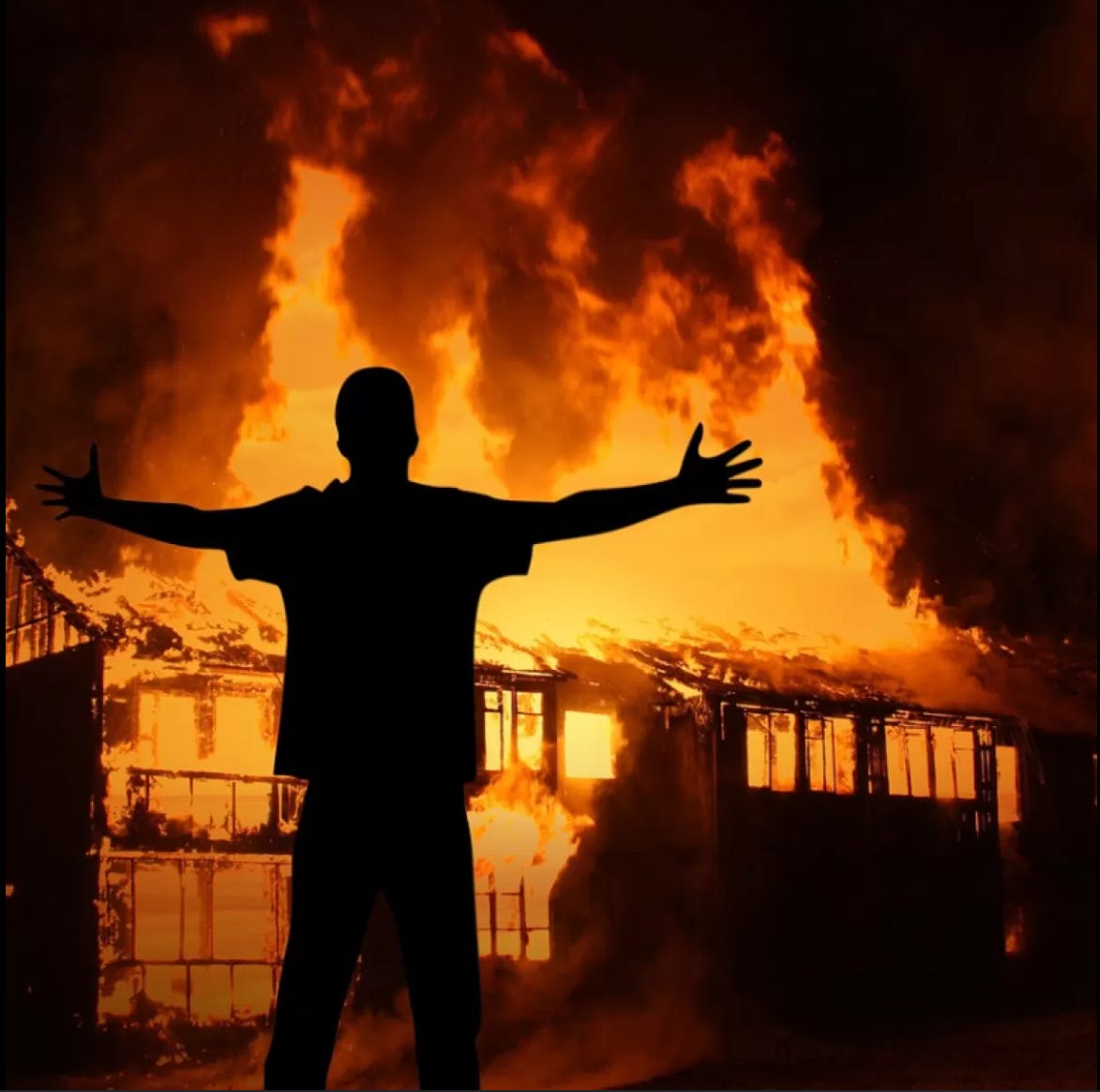
There are periods in history when wickedness arrives in jackboots and a banner, and then there are the more contemptible eras—our own among them—when it arrives as a press conference, a social-media post, and a committee of smirking incompetents.
The present disorder in the Middle East belongs very much to the latter category. The U.S.-Iran talks in Islamabad have failed, the war that began six weeks ago has now lurched toward an American naval blockade of Iranian ports, and the world is being asked to accept this as strategy rather than as the latest spasm of grandiose, violent improvisation.
Oil has leapt above $100, shipping has recoiled, and the planet is once again held hostage by men who confuse escalation with statesmanship.
Donald Trump, who should long ago have been laughed out of public life rather than returned to it, remains what he has always been: a pathological fabulist with the moral seriousness of a casino fire alarm. Even in this crisis, the boast outran the brief.
Trump publicly spoke in sweeping terms about blockading the Strait of Hormuz; his own military’s announced plan was narrower—traffic to and from Iranian ports, not every vessel traversing the waterway. This is the man in miniature: forever advertising omnipotence, forever corrected by reality, and forever leaving other people to reckon with the wreckage of his mouth. A buffoon is bad enough; a war buffoon is a planetary hazard.
Meanwhile, Gaza remains the black hole of the world’s conscience: the place where legal language, diplomatic caution, and media euphemism go to die.
The International Court of Justice case alleging violations of the Genocide Convention remains alive; UN experts have explicitly said that genocide continues in Gaza; Amnesty International has done the same. One need not pretend that every jurist on Earth has rendered final judgment in order to say that the evidence before our eyes is already an indictment of civilization.
Reuters reported this week that Israel’s campaign has left more than 72,000 Palestinians dead and much of Gaza in ruins. UNICEF’s February update said that by 3 February 2026, at least 21,289 children had been reported killed in Gaza. When a society grows accustomed to hearing those numbers and then asks for more context, it is not context that is lacking, but a soul.
And as this slaughter proceeds, the theft continues. Israel has approved 34 new settlements in the occupied West Bank, while earlier measures made it easier for settlers to buy land there. This is not an unfortunate administrative detail, nor some regrettable side-effect of security policy. It is the old and ugly thing itself: colonization under armed guard, annexation by increments, and the steady manufacture of “facts on the ground” designed to make justice appear impractical and dispossession irreversible.
The far-right Israeli ministers who speak with such candor about crushing Palestinian statehood deserve at least this much credit: unlike their Western apologists, they occasionally say plainly what they are doing.
As for the treatment of Gazan children, there is no decent language for it, which is why indecent euphemism has flourished. Children have continued to die even during the so-called ceasefire. Reuters reported an Israeli strike near a school sheltering displaced Palestinians on April 6 that killed at least 10 people; UNICEF said in January that more than 100 children had been killed in Gaza since the October ceasefire; UNICEF’s own humanitarian update records tens of thousands of children killed or injured since the war began.
To speak of “collateral damage” at this stage is not merely dishonest; it is obscene. When schools, shelters, tents, and starving families repeatedly become the stage-set for military explanation, the explanation itself becomes morally bankrupt.
Russia’s posture is easier to read than China’s because Moscow is saying the quiet part out loud: the Kremlin says the whole Middle East is “on fire,” and it has publicly supported ceasefires and mediation. Beijing has been less theatrical in the reporting I reviewed, but the strategic logic hardly requires an oracle.
A U.S. blockade that threatens energy flows, spikes oil prices, and brushes against maritime commerce involving Iran’s trading partners is precisely the sort of move that invites Chinese pressure, not necessarily in the form of a gunboat charge, but through diplomatic opposition, sanctions evasion, trade re-routing, and intensified support for any arrangement that humiliates Washington without forcing Beijing into a direct naval collision.
Reuters also reports experts warning that the blockade could create clashes involving major powers, including China. In other words: no one need send a fleet tomorrow for this to become a larger and uglier contest.
What, then, are the chances of a wider war? Higher than they were yesterday, lower than the apocalypse industry insists, and grave enough that only a fool would speak breezily of “containment.”
AP and Reuters both describe a fragile ceasefire, failed talks, unresolved disputes over Iran’s nuclear program and the status of Hormuz, and a blockade that even some experts treat as tantamount to an act of war. That is not a formula for stability; it is a formula for miscalculation.
The most likely near-term outcome is not an immediate world war, but a broadened regional war with periodic strikes, shipping attacks, infrastructure sabotage, and great-power confrontation by proxy and pressure. As for limited nuclear use, I would not call it likely on current public evidence. I would call it newly discussable—which is already a form of damnation. When a live nuclear dispute is being handled by vain men, maximalist demands, and threats against civilian infrastructure, the distance between the unthinkable and the merely improbable begins to narrow.
The deepest obscenity, however, is not simply that governments lie, or that armies kill, or that empires overreach. It is that millions of otherwise sentient people have trained themselves to applaud each fresh humiliation of fact, law, and humanity so long as it is performed in the livery of their tribe.
They will tolerate settlements because they call them neighborhoods. They will tolerate dead children because they call them shields. They will tolerate a disastrous war with Iran because they call it resolve. They will tolerate Trump because he calls his own vandalism strength. Thus does decadence end: not with a coup, but with a standing ovation for people who have made mendacity, cruelty, and recklessness into a governing style.
If there is any remaining task for honest people, it is to refuse the vocabulary of the arsonist. Gaza is not an unfortunate “optics problem.” West Bank annexation is not a zoning dispute. The Iran war is not a chess move. Trump is not a strongman but a swaggering blunderer whose every instinct is to lie, threaten, and then dare reality to repair itself.
And the world is not drifting into danger by accident; it is being shoved there by men who have discovered that, in an age of moral exhaustion, almost any crime can be repackaged as leadership. The bill, as ever, will be paid by civilians first, by soldiers next, and by the truth last of all.