

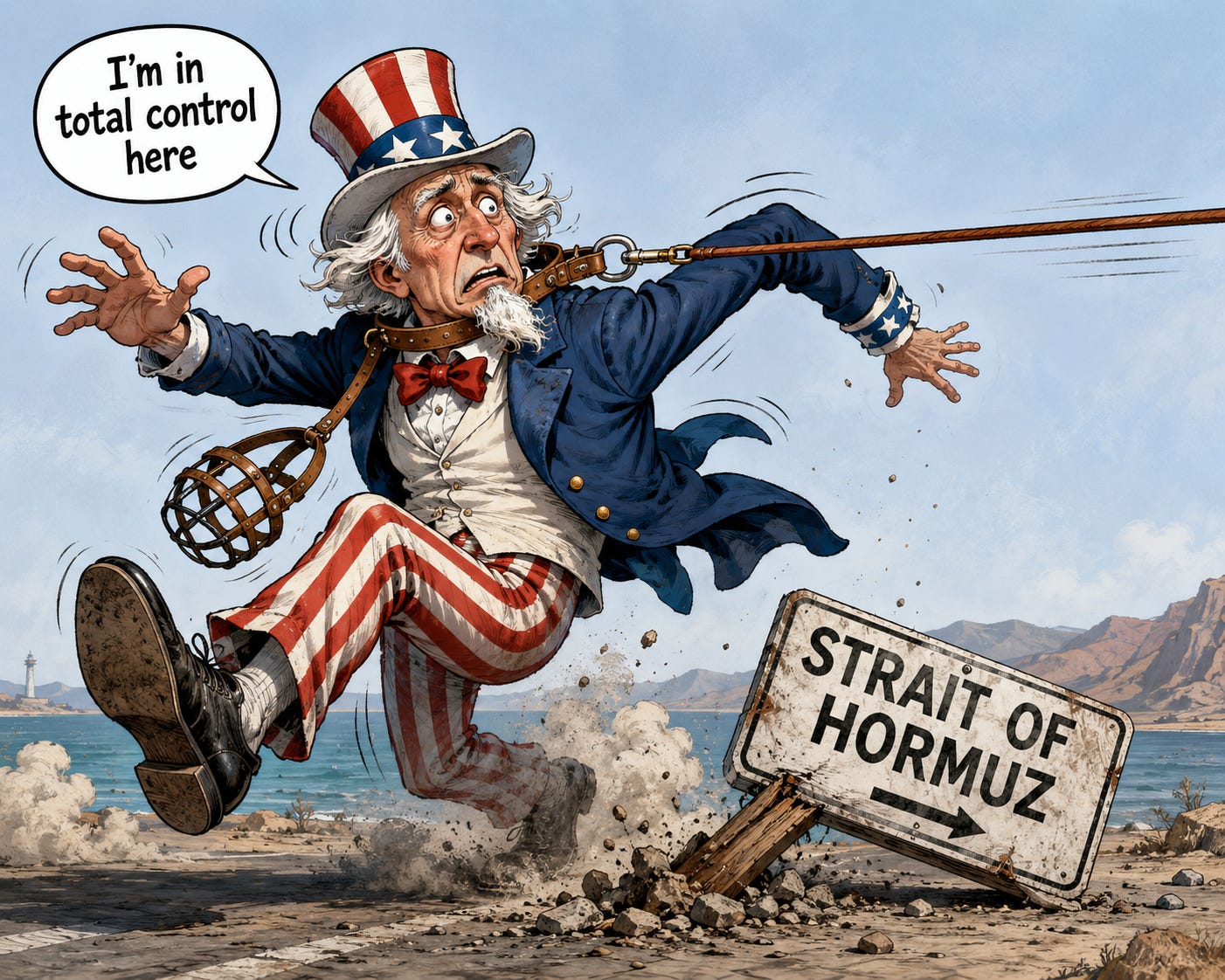
The Pentagon opened this war with a flourish worthy of a Bond villain: a decapitation strike that killed Iran’s Supreme Leader on the opening morning, an announcement of total, swaggering victory, and a phrase — “the Twelve Day War” — that somebody in the West Wing clearly hoped would end up chiseled into a monument, right next to the ones nobody visits anymore. That was February 28th. It is now the middle of August, the fighting has metastasized into what analysts are calling the Third Gulf War, the Strait of Hormuz is a demolition derby of tanker strikes, and the Secretary of State recently spent an afternoon as human bait on an airplane he didn’t know was a decoy. Somewhere between the victory lap and the decoy jet, America stopped writing this war and started merely appearing in it, a supporting player billed above the title.
Let’s be honest about what actually happened, because the administration certainly won’t be. The United States and Israel opened with a strike so audacious it briefly looked like genius — take out the Ayatollah, cripple the nuclear program, watch the regime collapse under its own rot, the sort of tidy regime-change fantasy that has seduced every American administration since roughly the Eisenhower years and delivered on its promise almost never. Instead, Iran’s leadership reconstituted, its proxies scattered fire across half a dozen countries, and a war sold as a long weekend has now outlasted most presidential honeymoons. The April ceasefire lasted about as long as a Kardashian marriage. The June memorandum of understanding fared little better — a diplomatic instrument with the structural integrity of a wet paper bag. Five and a half months in, the two central American war aims — a secured Strait of Hormuz and a signed deal — remain exactly as elusive as they were in March, except now they’re costing six consecutive days of rising oil prices and a Navy deployment the President himself admits isn’t “nearly long enough.”
And then there’s the tanker traffic. The President stood before cameras and declared, with the epistemic confidence of a man who has never once in his life been demonstrably wrong about anything, that the United States maintains total control of the Strait of Hormuz. Within about a day, two UAE-flagged tankers were struck transiting that very strait, and an Iranian paramilitary commander was on record insisting the waterway belongs to Tehran. This is the rhetorical equivalent of insisting you’ve tamed the dog while it drags you face-first through the neighbor’s rose bushes, barking the entire way, the leash wrapped twice around your own throat. Somebody, please, get the man a muzzle. For himself.
But the detail that should have every American asking uncomfortable questions about who is actually steering this war arrived a few days ago in Ankara. Reporting from the Times of Israel, the Wall Street Journal, and CNN converged on the same extraordinary scene: intelligence — supplied by Israel — indicated a credible plot to shoot down Air Force One with a shoulder-fired missile. So the President was quietly smuggled off the plane, reportedly in a catering truck (one hopes, at minimum, a clean one), onto a smaller aircraft bound for a British military base. Left behind on the original 747, unaware the President was no longer aboard, sat the Secretary of State and the Treasury Secretary, doubling as unwitting decoys for a threat their own government had assessed as real enough to abandon them to it.
Sit with that for a second, because it will not improve on second viewing. The chief diplomat of the most powerful nation on Earth was, by design or by negligence, turned into airborne chaff — and the intelligence driving the entire operation came from Jerusalem, not Langley. If you wanted a single tableau to capture the actual power dynamic in this arrangement, you could not improve on Marco Rubio sipping his complimentary Sprite at thirty thousand feet on a jet he’d been told, by someone else’s spy agency, might get shot out of the sky. Somewhere, George Smiley is pouring himself a very stiff drink, and shaking his head at amateurs.
Now, the obvious objection, the one some think-tank fellow is already drafting an op-ed about: intelligence-sharing between friendly states is routine, and prudent threat response isn’t submission, it’s competence. Fine. Except competence doesn’t usually look like your own cabinet officials finding out about a credible missile threat to their own aircraft after the fact, from a foreign intelligence service, while the boss has already vanished into a catering truck bound for parts unspecified. That’s not the healthy division of labor between two allies. That’s discovering, mid-flight, that you are a subcontractor in an operation run out of someone else’s capital.
None of this is an argument for a warmer embrace — quite the reverse. Israel is not a treaty ally. There is no mutual defense pact, no Article 5 equivalent, nothing binding Washington to this arrangement beyond decades of habit and an extraordinarily effective lobbying operation. It is a relationship built on sentiment and appropriations bills, not law — which makes it exactly the sort of relationship a sober country revisits once it notices it is paying the invoice for a war it does not control, run partly on intelligence supplied by a state with its own long and undenied history of spying on its benefactor, Jonathan Pollard being merely the case they got caught on. Entangling the American military and intelligence apparatus more tightly with a foreign government that owes Washington no reciprocal legal obligation, and has previously turned its espionage on Washington itself, is not alliance-building. It is volunteering for a marriage with no vows, no exit clause, and a spouse who has already gone through your desk drawers.
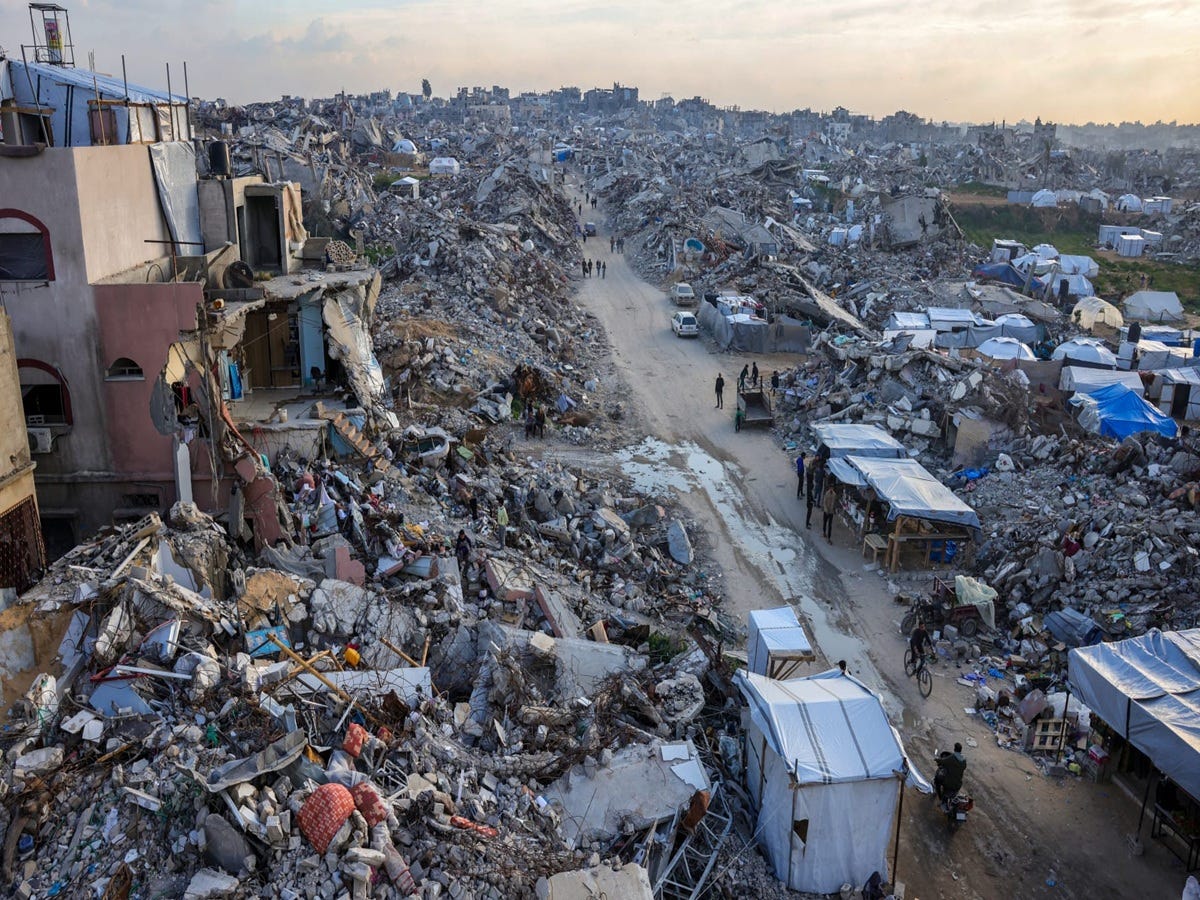
This is not a trash heap, it’s what’s left of Gaza.
There is also, one might add, a small matter of conscience that no amount of shared radar coverage will launder away — and let’s be precise about what conscience means here, because Netanyahu’s own office has a script ready for anyone who raises it: call it antisemitism and change the subject. It’s a tired trick and worth naming as one. Opposing this Israeli government’s conduct is not hatred of Jews, any more than opposing the Kremlin is hatred of Russians, and the conflation is itself an insult to actual antisemitism — it trivializes the real thing every time it gets deployed as a shield the moment criticism lands too close to home. The International Criminal Court doesn’t traffic in insults. In November 2024 its Pre-Trial Chamber found reasonable grounds to believe Benjamin Netanyahu personally bears criminal responsibility for war crimes and crimes against humanity — starvation as a method of warfare, the deliberate targeting of civilians — and issued a warrant for his arrest that remains active today, having survived Israel’s own appeal. That is not a conviction; the bar for a warrant sits lower than the bar for a verdict, and Israel disputes every syllable of it. But it is not nothing, and it is a great deal more than an opinion column’s worth of outrage. The ICJ, separately, is still years from a final ruling on South Africa’s genocide case, though its provisional measures already found the allegations plausible enough to order Israel to prevent genocidal acts and feed a starving population — an order it has treated with roughly the seriousness of a parking ticket. Add it up: more than twenty thousand children reported dead by health officials in Gaza, a sitting head of government wanted by an international court, and an American alliance built on nothing sturdier than sentiment. If the word Nuremberg makes people uncomfortable in this context, good — it should. A reckoning of this scale doesn’t get settled by a hashtag. It gets settled by an actual tribunal, which is precisely the mechanism now sitting open and waiting.
The deeper problem isn’t the decoy flight, farcical and almost operatic as it is — it’s what the decoy flight reveals, and what the moral ledger confirms. This war’s tempo, its targeting decisions, its extensions and escalations, have been set again and again by Jerusalem, with Washington playing catch-up, ratifying decisions after the fact, and absorbing the blowback when things go wrong — as they did in February, when a Tomahawk strike hit a school in Minab and killed 168 people, most of them children, in an operation a preliminary U.S. investigation reportedly attributed to American forces. Israel gets the strategic tempo, the initiative, the narrative. America gets the casualty reports, the oil price spikes, and the grim privilege of writing the checks — for a partnership it never actually signed, in service of a government that a sitting international court has already found reasonable grounds to prosecute.
So here is the constructive contempt, the part where this stops being a jeremiad and starts being a proposal, because scorn without a remedy is merely noise with a better vocabulary. Congress should reassert the war powers it has spent three administrations outsourcing to the executive branch, forcing an actual floor debate and vote before another dollar or another sortie is committed to an unincorporated war. The fused targeting and intelligence-sharing arrangements that put a Secretary of State on a decoy plane he didn’t know he was riding should be unwound, not deepened — American verification, American targeting authority, American command of American assets, full stop, with no foreign intelligence service holding functional veto power over the President’s flight plan. Washington should also stop treating other countries’ Rome Statute obligations to arrest a wanted man as an inconvenience to route around — if the reckoning the ICC has already opened is going to mean anything, protecting Netanyahu’s travel calendar is not a service America owes anyone. And Washington should finally do the boring, unglamorous work of deciding, out loud and on the record, what this relationship actually is — an interest, not a marriage, and one now shadowed by a genocide docket at the Hague and a wanted man’s arrest warrant — so the next war doesn’t get run on someone else’s clock, in someone else’s moral custody.
Six months ago this was supposed to be over in twelve days — Blitzkrieg dressed up as foreign policy. It is instead an unresolved war, an unsecured strait, an escalating body count, and a Secretary of State who briefly moonlighted as skeet in an operation Washington didn’t plan and barely controlled. The United States doesn’t need to hold this leash more tightly. It needs to notice there was never a collar on its own neck to begin with, ask itself exactly whose war it has been financing and whose conscience it has been renting — and cut the thing loose before the next flight, the next tanker, the next invoice comes due.
Great piece!